

 Buy with Prime



The most repeated tip in DIY circles is simple. Grab the bottle with the biggest vitamin E number, call it mixed tocopherols, and assume the oil stays fresh while skin looks better. That advice treats mixed tocopherols vitamin E as a stronger version of one vitamin. It isn't.
A mixed material is a blend of related molecules. The useful skill is reading the isomer profile, the assay, and the carrier so the blend matches oil protection. A bigger percentage on the front label doesn't tell you which forms are inside, or whether you're looking at vitamin activity or total tocopherol mass.
If you make face oils, lotions, or hair oils, you're buying an antioxidant for unsaturated oils, not a score to win. What follows walks a bottle the way a formulator would, with a hard line between cosmetic look and feel and anything a drug listing would claim.
Table of Contents
- What Mixed Tocopherols Vitamin E Really Is
- Mixed Tocopherols Compared with Alpha-Tocopherol
- Label, Sourcing, Allergen and Storage Checks
- Skin and Hair Uses That Stay Cosmetic
- DIY Concentrations and Mixing Steps
- Pair Vitamin C and Peptides Then Mix a Serum
What Mixed Tocopherols Vitamin E Really Is
Think of a toolbox, not one wrench. You wouldn't call a hammer, a screwdriver, and a file "a bigger wrench" just because they sit in the same box. Mixed tocopherols vitamin E works the same way. The NIH Office of Dietary Supplements describes vitamin E as a family of eight naturally occurring forms: alpha-, beta-, gamma-, and delta-tocopherol, plus four matching tocotrienols.
Only alpha-tocopherol is recognized as meeting human vitamin E needs. That's why recommendations and labels use alpha-tocopherol equivalents instead of treating every tocopherol as interchangeable. The U.S. adult Recommended Dietary Allowance is 15 mg of alpha-tocopherol per day, and the Daily Value on U.S. nutrition labels is also 15 mg for adults and children aged 4 years and older. That 15 mg figure is not total tocopherol mass. A bottle can hold a lot of gamma and delta and still contribute little alpha activity.
In the U.S. diet, gamma-tocopherol is especially common because soybean, canola, corn, and other vegetable oils supply it. Food composition databases can list alpha, beta, gamma, and delta separately, so a natural oil is a profile, not a single vitamin E number. The liver protein that keeps vitamin E, alpha-TTP, doesn't treat the four forms equally. Use that preference as a lookup, not as a ranking of which form protects an oil.
| Form | Where it usually shows up | Relative alpha-TTP preference | Formulator takeaway |
|---|---|---|---|
| Alpha-tocopherol | Supplements, fortified foods, many vitamin E labels | About 100% | The form used for vitamin E nutritional equivalence |
| Beta-tocopherol | Minor amounts in some vegetable oils | Minor compared with alpha | Rarely the reason to buy a mixed blend |
| Gamma-tocopherol | Soybean, canola, corn, and other vegetable oils | About 8.9% | Often the largest slice of a natural mixed blend |
| Delta-tocopherol | Smaller share of many seed-oil distillates | About 1.6% | Valued in oil protection, not as vitamin E activity |
Say you're comparing two jojoba blends for a face oil. One is mostly alpha and looks strong on a vitamin E line. The other is gamma-heavy with a modest alpha share. The first is the clearer match when you need to talk about vitamin E activity. The second can still be the better match when the job is keeping unsaturated oils from smelling stale. People who study antioxidants in face creams run into this split all the time.
Practical rule: Ask what the number counts. Alpha activity and total tocopherol mass are different measurements.
A mixed-tocopherol material can contain several homologues, while its nutritional vitamin E value is judged mainly through alpha-tocopherol activity. The next comparison uses that profile to separate antioxidant behavior in a bottle from isolated alpha-tocopherol.
Mixed Tocopherols Compared with Alpha-Tocopherol
Each tocopherol carries a chromanol ring. The hydroxyl group on that ring can hand a hydrogen to a lipid peroxyl radical, which breaks an oxidation chain in oils the way a firebreak stops a grass fire from running the field. Alpha, beta, gamma, and delta all share that chemistry. They don't share the same job once you put them in a formula.
A 2025 review in Basic & Clinical Pharmacology & Toxicology reports relative binding to hepatic alpha-tocopherol transfer protein of about 100% for alpha, 8.9% for gamma, and 1.6% for delta. That preference explains biological vitamin activity. It doesn't decide how well a blend guards an oil. Isomers differ in reactivity, concentration, where they sit in the oil phase, and whether another antioxidant can regenerate them.
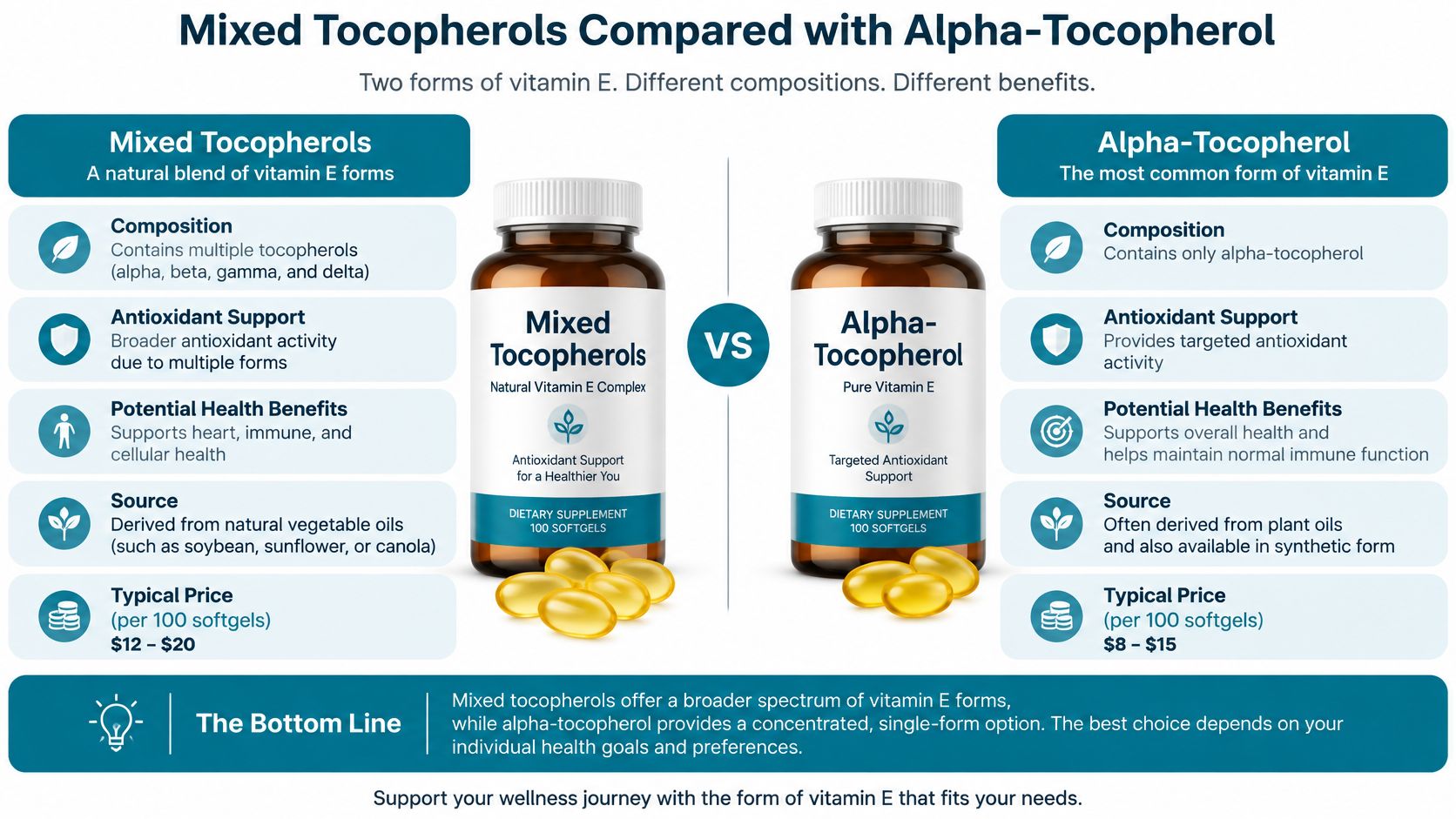
| Question | Mixed tocopherols | Alpha-tocopherol alone |
|---|---|---|
| What it is | Blend of alpha, beta, gamma, and delta | One isolated form |
| Vitamin E activity | Driven mainly by the alpha portion | The reference form for activity |
| Best cosmetic job | Protect unsaturated oils and oil-soluble extras | When a specific alpha level is the point |
| What to request | Isomer profile, assay, carrier, peroxide value | Assay and whether it is natural or synthetic |
| What a high percent does not mean | Not automatically better skin results | Not automatically better oil protection |
Pick by the job, not the percentage
Use declared alpha-tocopherol content when you need nutritional equivalence language, such as comparing a supplement label with the 15 mg Daily Value idea. Judge the full isomer blend when the goal is keeping unsaturated carrier oils, botanical extracts, and fragrance components from oxidizing. A gamma- and delta-rich mix can do that job even when the alpha share is modest.
Isolated alpha-tocopherol is the cleaner purchase when a formula spec calls for a stated alpha level and nothing else. It is not automatically the better shield for a rosehip or hemp oil. A high nominal "vitamin E" percentage doesn't scale stability in a straight line.
A peroxide-value check, or an accelerated oxidation test on the finished formula, tells you more than the percentage printed on the drum.
Specify a mixed raw material by individual isomer profile, assay, carrier oil, and peroxide value. Don't buy it as a single vitamin E percent and hope the oil behaves.
Label, Sourcing, Allergen and Storage Checks
"Mixed tocopherols" is a category name, not a recipe. Two suppliers can print the same words and ship very different liquids. The NIH vitamin E fact sheet for health professionals notes that labels may say only "mixed tocopherols" without the proportion or milligram amount of each form. Its supplement-label examples run from products listing mixed tocopherols alongside 180 mg of vitamin E to labels that split out alpha, beta, gamma, and delta. Another label lists 50 mg of mixed tocotrienols separately from 12 mg of alpha-tocopherol. Tocotrienols are relatives. They are not the same four tocopherols, and they shouldn't be folded into a tocopherol claim.
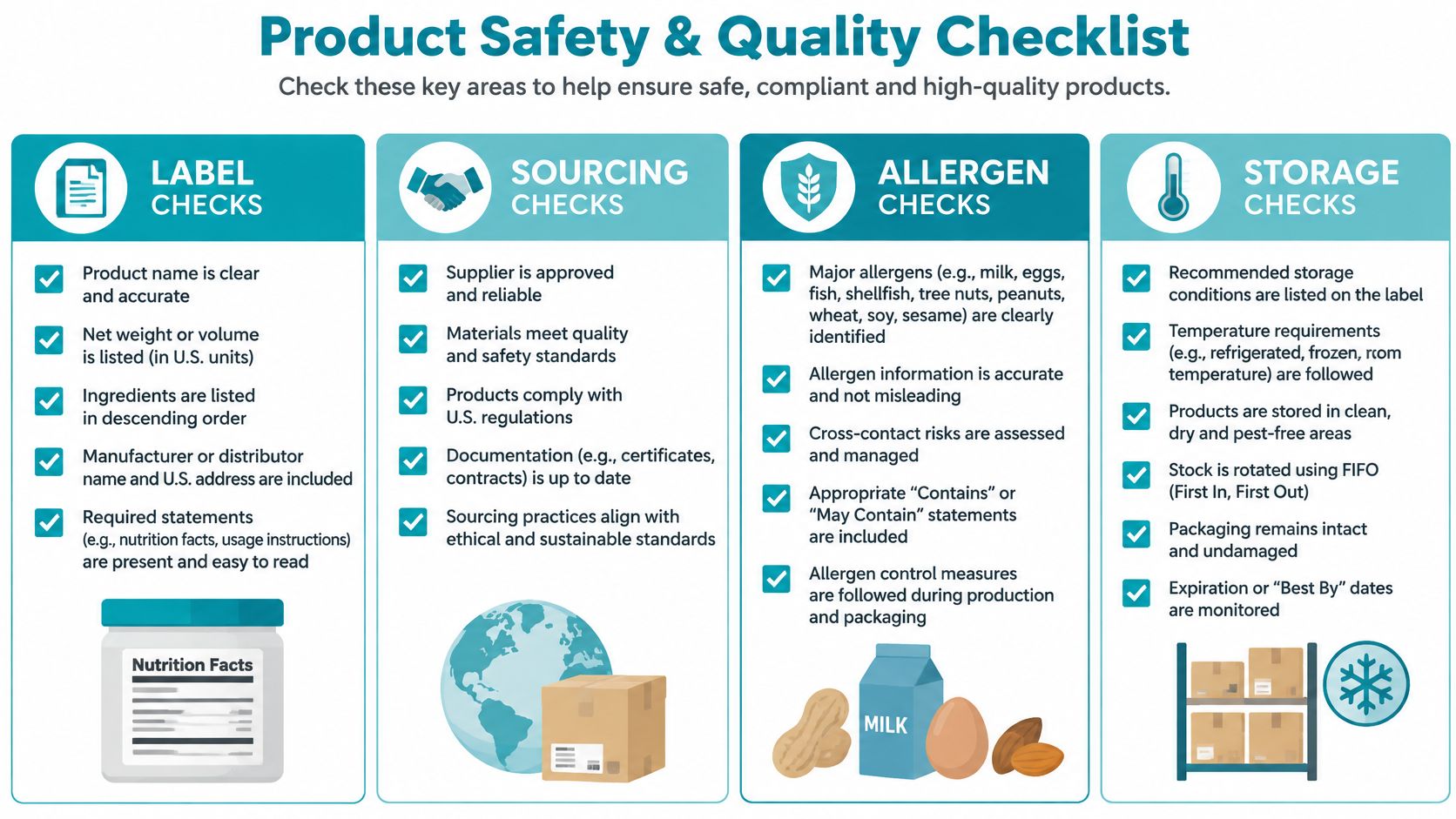
Read the certificate in this order
- Isomer percentages that add up. Alpha, beta, gamma, and delta should be listed, and the shares should total about 100% of the tocopherol portion.
- Assay as tocopherol, not as vitamin E activity. A higher milligram figure may be total mass. It is not automatically more alpha activity, and it is not proof of better topical performance.
- Named carrier oil. Many concentrates are cut into soybean or sunflower oil. The carrier changes allergens, scent, and how the drop weighs.
- Peroxide value, with a date. A fresh number tells you the oil hasn't already started to oxidize in the drum.
- Plant source in writing. Most commercial mixed tocopherols are distilled from soybean oil. Sunflower is the usual soy-free option. Refining removes almost all protein, yet a highly sensitive customer may still want sunflower. The INCI name tocopherol won't answer that question.
Shop bulk skin care ingredients with the certificate in hand, not the marketing line on the jug.
Store it before you mix
Keep the raw material cool, dark, and tightly capped in its original amber or opaque bottle. Write the opened date on the label. A refrigerator is fine if condensation stays out of the neck. Warm, wet air at the threads does more harm than a cool cupboard. Discard material with a sharp paint-like smell, or darkening far past the color on the certificate. Oxidized tocopherol won't protect your carrier, and it can add an off note to a face oil.
Buyer checklist before the first batch: profile present, carrier named, peroxide value recent, botanical source written down, and tocotrienols kept off the tocopherol line. If any of those is missing, ask the supplier before you pour.
Skin and Hair Uses That Stay Cosmetic
In a face oil, body oil, or hair oil, mixed tocopherols are an oil-phase helper. They can slow the oxidation that makes unsaturated oils smell stale, and they add a soft, rich slip. People often smooth a few drops of a vitamin E oil over dry-looking ends or cuticles, or use a thin oil as the last step over a serum for a dewy finish. That is a fair description: antioxidant support inside the formula, plus a cosmetic feel.
It is not a clinical result. A Frontiers in Pharmacology review cites one topical photosensitivity experiment that used 10% tocopherols and only 0.3% tocotrienols in 15 participants. That design doesn't show that ordinary mixed-tocopherol skincare lifts lines, rebuilds collagen, regrows hair, or stands in for sunscreen. Tocotrienol papers and everyday tocopherol oils are not the same evidence. "Natural," "mixed," or "high potency" is not proof of a stronger cosmetic result.
Oral supplements are a separate topic. The same review notes that high-dose safety data remain limited, even where doses up to 1,000 mg a day have appeared tolerable for adults. This article is not a dosing plan for pills. A drop in a hair oil is not a capsule.
What a listing may say
Under the Federal Food, Drug, and Cosmetic Act, a cosmetic is applied for cleansing, beautifying, promoting attractiveness, or altering appearance. A product intended to diagnose, cure, mitigate, treat, or prevent disease, or to affect the body's structure or function, is a drug. FDA reads intended use from labeling, ads, and internet claims. Restoring hair growth, reducing cellulite, treating varicose veins, increasing or decreasing melanin, or regenerating cells are examples that can create drug status.
The FDA's cosmetics labeling claims page is clear that FDA doesn't preapprove cosmetic products or a list of claims before sale. Selling a cosmetic doesn't make it FDA-approved. Claims still have to be truthful and not misleading. If the words say a product treats disease or affects structure or function, including the skin, drug rules apply. FDA handles labeling. The Federal Trade Commission handles advertising.
Etsy's medical claims policy also bars statements that an item prevents, heals, treats, diagnoses, mitigates, or cures a disease or medical condition, whether or not the seller thinks the line is accurate.
Wording that stays cosmetic: "Helps the look of dry ends." "Supports a smooth-feeling oil." "Adds slip to a leave-on hair oil."
Wording to leave off a listing: "Heals skin." "Repairs the barrier." "Treats eczema." "FDA-approved vitamin E oil."
Pair tocopherols with stable butters and oils when you want scent and texture to hold, and describe the result as appearance and feel.
DIY Concentrations and Mixing Steps
Rates come before the story. Weigh mixed tocopherols against the oil phase, not the whole jar.
| Product | Where it goes | Watch-out |
|---|---|---|
| Carrier oil protection, 0.05% to 0.2% | Dissolved in the carrier oil | Recheck smell and peroxide if the oil is very unsaturated |
| Face or body oil, 0.5% to 1% | Entire oil phase | Above 1% to 2% often feels sticky |
| Cream or lotion oil phase, 0.05% to 0.2% | Cool-down oil phase | Do not calculate on the water phase by mistake |
| Hair oil for ends, 0.2% to 0.5% | Leave-on oil | Heavy film if the rate is high |
| Water-based serum, same oil-phase rate | Pre-dissolved in oil or solubilizer | Neat tocopherol will not disperse in water |
Above about 1% to 2% in a leave-on oil, many formulas feel sticky, and old tocopherol can oxidize on its own. More is not automatically better. Hair oils often stay near 0.2% to 0.5% so ends feel conditioned without a heavy film.
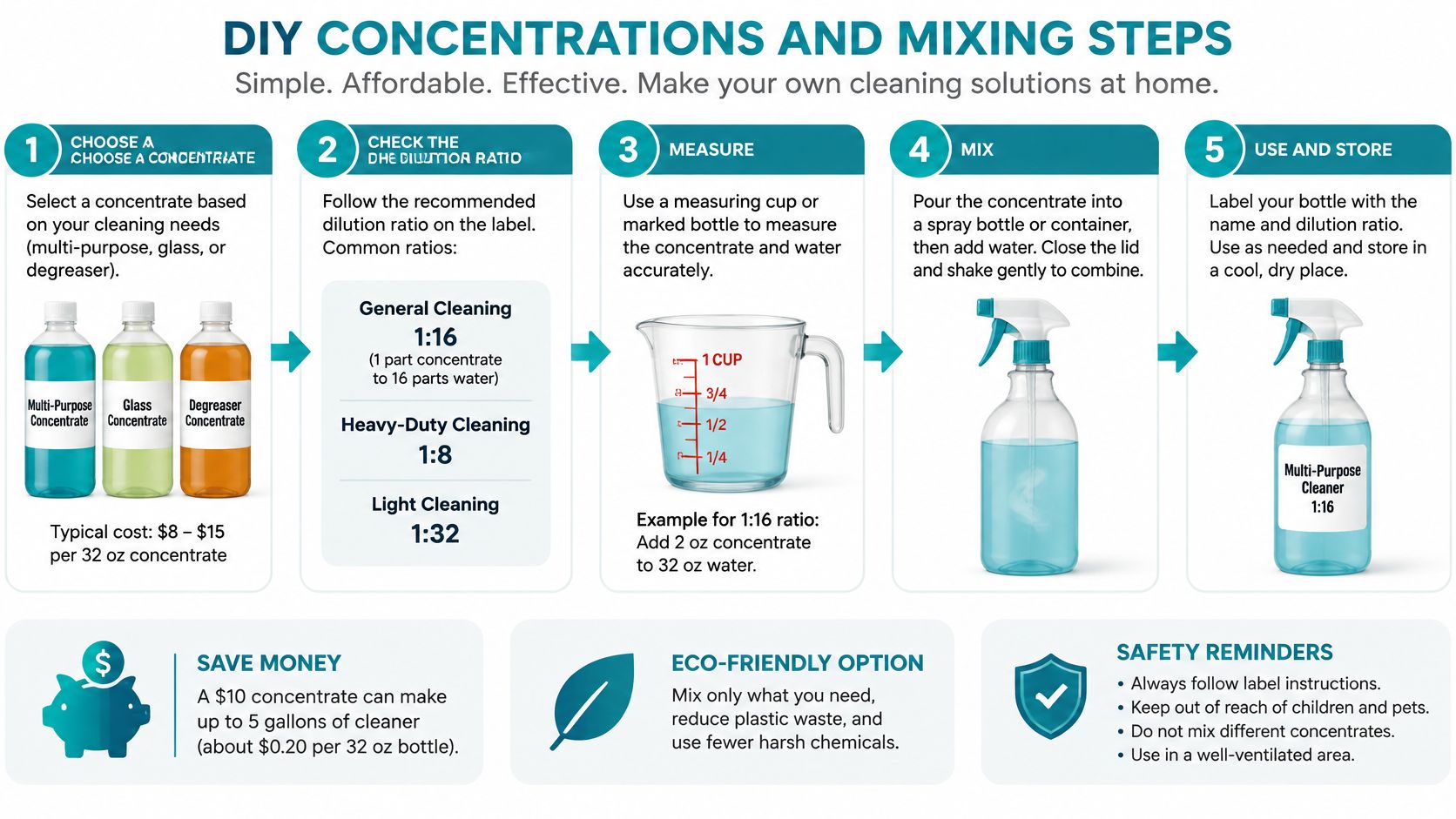
Weigh, then stir
- Weigh the carrier oil on a 0.01 g scale. For a protective level, 0.1 g of mixed tocopherols in 100 g of jojoba is 0.1%.
- Warm only if the oil is solid. Keep butters just fluid, well under temperatures that scorch botanicals. Jojoba and fractionated coconut don't need heat.
- Weigh the tocopherols into the oil and stir until the mix is clear. Cloudiness usually means it isn't dispersed yet.
- Add fragrance or oil-soluble extracts after the antioxidant is already in the oil, so those extras meet a protected phase.
- For a cream, add this oil phase at cool-down, at the temperature your base recommends. Don't dump tocopherol into the water phase and stir harder.
- Label the percent, date, and source on the bottle, and keep the certificate with the batch notes.
- Patch-test a new leave-on on a small area of skin before you use it more widely.
Two slips cause most bad batches. People calculate the percent on the whole jar after they only weighed the oil, so a lotion looks under-dosed on paper and overdosed in the oil. Or they snip a sticky vitamin E capsule whose carrier and assay are unknown. Capsule oil is a supplement, not a controlled cosmetic raw material.
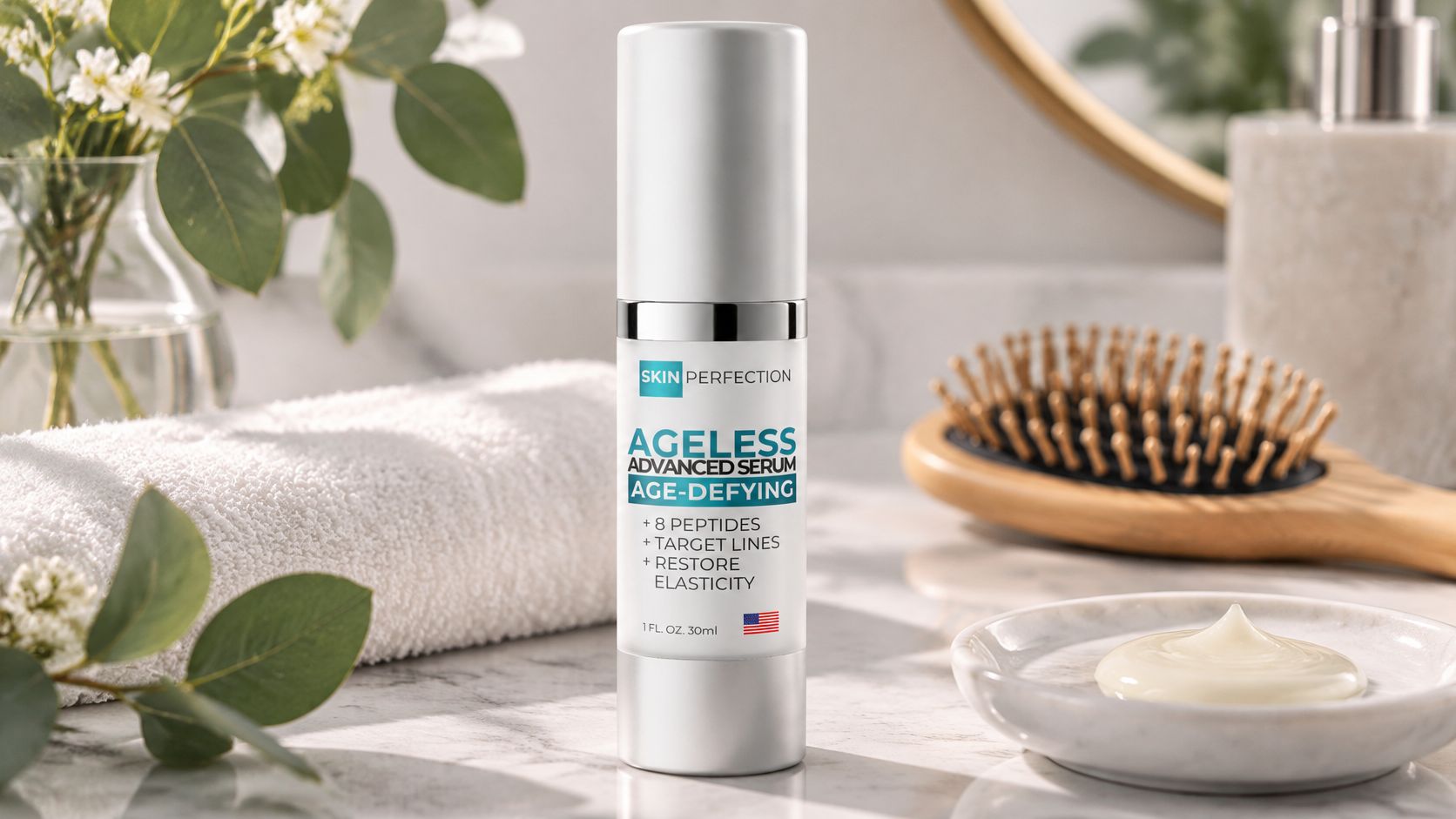
A finished peptide serum is a different phase from this oil. Ageless Advanced Age-Defying Serum is a 1-ounce airless peptide serum, free of parabens, with ingredients such as Matrixyl Synthe 6 and Syn-Coll, sold for the look of fine lines. It isn't a place to drip neat tocopherol. If you're building the oil yourself, the cosmetic formulation notes on phase order will save a cloudy bottle.
Pair Vitamin C and Peptides Then Mix a Serum
Tocopherols live in the oil. A stable vitamin C derivative such as sodium ascorbyl phosphate lives in water. Pour oil-phase tocopherol into a watery vitamin C bottle and it beads up on the surface. It doesn't dissolve, and it doesn't "boost" the watery serum by sitting on top.
Peptides such as Matrixyl, Argireline, or Syn-Coll also belong in the water phase. A practical split is a vitamin C serum in the morning under sunscreen, then an oil or cream that already contains mixed tocopherols in the evening, with a lightweight peptide serum underneath. What you're supporting, in appearance terms, is a luminous look, an even-looking tone, and a smoother feel.
For a ready antioxidant step, start from vitamin C powder for the face guidance and keep that mix water-based. For a custom water phase, the Rejuvenate Anti-Aging Serum Base is a 4-ounce paraben-free vegan serum base in a white jug. Peptide or antioxidant boosters are sold separately, so you set the concentration. Add mixed tocopherols only to the oil portion of a custom formula. Label the cosmetic use in appearance language, and file the certificate with the batch notes.
Skin Perfection makes plant-based skincare and the lotion-making supplies formulators use when they want mixed tocopherols matched to an oil, not guessed from a vitamin E percentage. You'll find ready serums for a luminous look and bulk bases for custom oil and water phases. Visit Skin Perfection to choose a serum or a DIY supply that fits the phase you're mixing.