

 Buy with Prime



If peptides are so promising, why can two peptide serums leave your skin looking and feeling different? The ingredient name doesn't tell you how much is present, whether it remains stable, or what the complete product has demonstrated. Understanding peptide serum benefits starts with separating a plausible mechanism from a measured result.
Table of Contents
- Peptide Serum Benefits at a Glance
- What Peptides Are and How They Reach Your Skin
- What the Clinical Studies Actually Measured
- Choosing a Formulation and Concentration That Works
- Safety Limits and When to Pause Peptide Serums
- Layer Your Peptide Routine and Track Results
Peptide Serum Benefits at a Glance
Peptide serums have their clearest support for hydration and skin-barrier function, with encouraging evidence for smoother texture and overall appearance. Firmness, elasticity, and fine-line changes deserve more cautious expectations because the human evidence is narrower and more formula-specific.
Peptide serum benefits ranked by evidence strength
| Benefit | What Studies Measured | Evidence Strength | Realistic Timeline |
|---|---|---|---|
| Hydration and skin barrier | Lower water loss through the skin in a 12-week trial | Moderate, small samples | 6-12 weeks |
| Texture and smoothness | Participants rated skin smoother after 12 weeks | Moderate, partly self-reported | 6-12 weeks |
| Radiance and overall appearance | More users reported a better look than controls | Moderate, small samples | 12 weeks |
| Firmness and elasticity | Instrumental readings in topical collagen-peptide studies | Limited, few randomized trials | 12 weeks or longer as an evaluation window, not a proven deadline |
| Fine and expression lines | Wrinkle appearance in signaling-peptide studies | Emerging, mostly small or supplier-led | 12 weeks or longer as an evaluation window, not a guarantee |
These are appearance-level or skin-condition outcomes, not evidence that a cosmetic changes every layer of the skin. Results belong to the particular peptide, concentration, and base tested; much of the available clinical work involves small groups followed for relatively short periods.
Ingredient education is useful beyond peptides, too. Sphagnum Botanicals' guide to Nordic peat mud in skin care offers another ingredient-focused resource, but evidence for one ingredient category shouldn't be transferred to another.
A peptide serum earns its place for hydration and texture first. Firmness and line results are a reason to test, not a promise.
A useful buying decision connects the proposed mechanism with finished-product testing, a suitable concentration, tolerable layering, and a consistent routine. Your practical benchmark is a realistic expectation for each benefit and a clear window in which to judge it, rather than an open-ended commitment to an expensive bottle.
What Peptides Are and How They Reach Your Skin
A peptide is a short chain of amino acids. Amino acids work like letters, a peptide works like a short word, and the serum works like the envelope carrying that word to your skin.
The analogy has a limit: delivering an envelope to the surface doesn't establish that its message reaches the intended recipient. The peptide must remain stable, leave its base, and arrive at a location where it can produce the proposed effect.
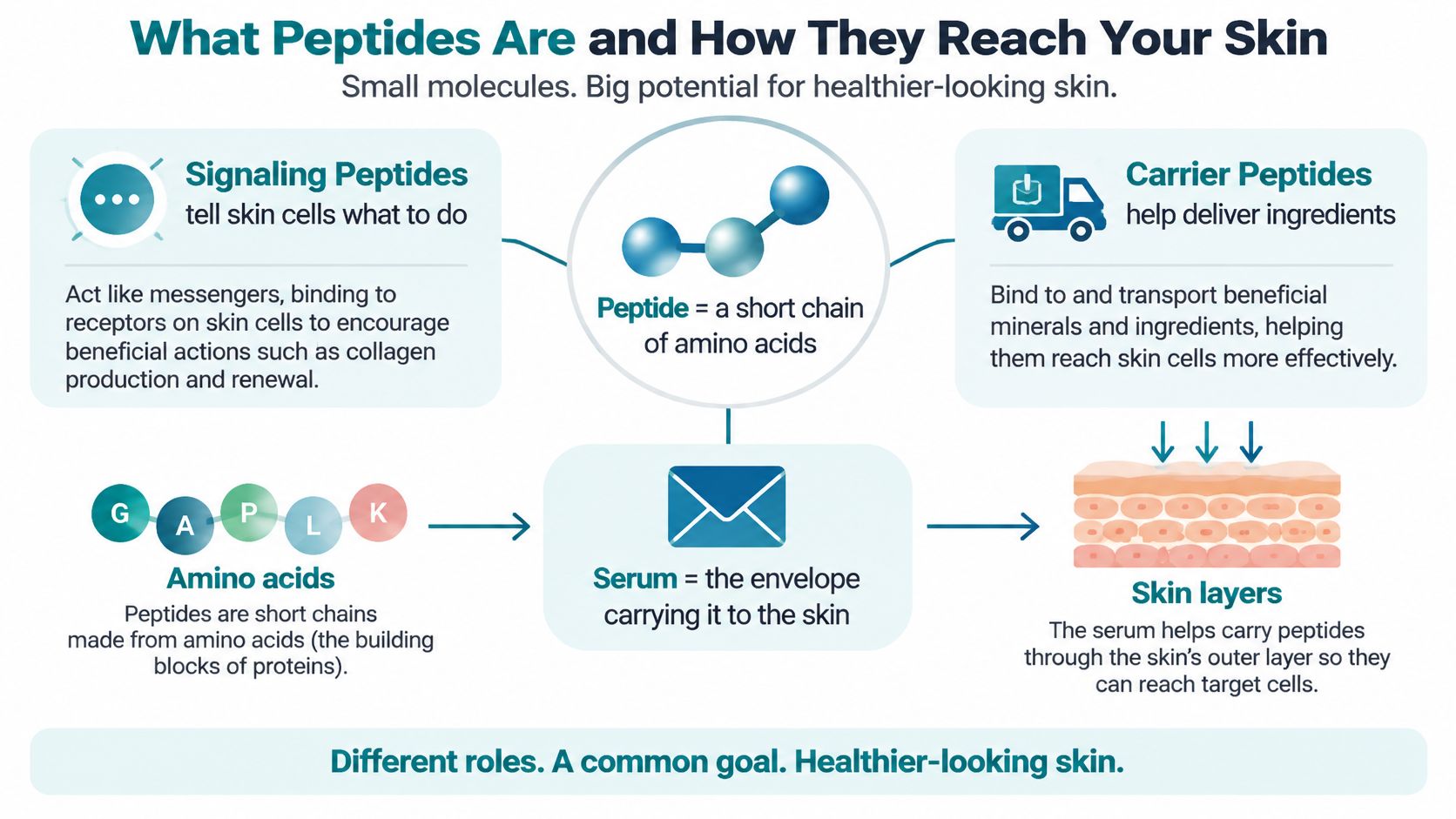
Different peptides have different jobs
Signaling peptides are studied for interactions with cell pathways associated with structural proteins. Conventional collagen peptides are collagen-derived molecules that may remain largely at the surface unless their formulation provides effective delivery.
A cosmeceutical review published by Springer describes topical findings involving moisture, collagen density, firmness, elasticity, and wrinkles, while emphasizing limited conventional collagen-peptide evidence and the need for rigorous randomized, double-blind human trials. A proposed collagen-related mechanism describes what a peptide could do in principle; your serum still needs its own finished-product evidence for deeper firmness.
Carrier peptides are another category, distinct from collagen peptides and from delivery carriers such as liposomes. The overview of what bioactive peptides are can help you distinguish ingredient terminology before comparing labels.
Why the envelope matters
The outer stratum corneum restricts passage of many large, water-soluble molecules. Surface enzymes can also break down peptides before they reach their intended target.
Formulators respond with smaller fragments, lipid carriers such as liposomes, or penetration enhancers. Those choices describe a delivery strategy, and whether a meaningful amount reaches deeper skin during everyday use depends on the specific product and how it was tested. A peptide that stays active at the surface can still matter for hydration, since the stratum corneum is where water retention happens.
Hydration deserves its own explanation rather than being treated as evidence of collagen change. Buy Me Japan's discussion of daily hydration in Japanese skincare provides useful background for understanding the moisturizing side of a routine.
A peptide on the label tells you what was added, and the finished product tells you whether it works.
When reading a label, look for recognizable names containing dipeptide, tripeptide, pentapeptide, or hexapeptide, often followed by an identifying number. Ingredients generally appear in descending order, although low-level ingredients have labeling exceptions, so position alone can't reveal an exact dose.
Use this checklist:
- Peptide identity: Look for specific ingredient names, rather than a proprietary blend name alone.
- List position: Treat it as a clue rather than a concentration measurement.
- Carrier system: Ask what supports delivery and whether it was evaluated.
- Stability and preservation: Check storage directions and handling requirements.
- Finished-product testing: Prefer results for the serum you'll use.
What the Clinical Studies Actually Measured
A lower water-loss reading is more informative than a vague promise of youthful skin. It tells you what investigators measured, although it still doesn't tell you that every peptide product will perform similarly.
In a double-blind, vehicle-controlled clinical investigation published in the Journal of Cosmetic Dermatology, 22 women aged 47-65 used an OS-01 peptide-containing facial formulation, and their transepidermal water loss ran 14-18% lower than baseline at 6 and 12 weeks, statistically significant at both points (p<0.001 at week 6, p=0.011 at week 12). Participants also reported better hydration, smoothness, radiance, and overall appearance.
That is the same finding the at-a-glance table summarizes in a single hydration line. What the summary can't show is the split inside it: the percentage came from an instrument, while the smoother, more radiant reports came from the participants' own assessment.
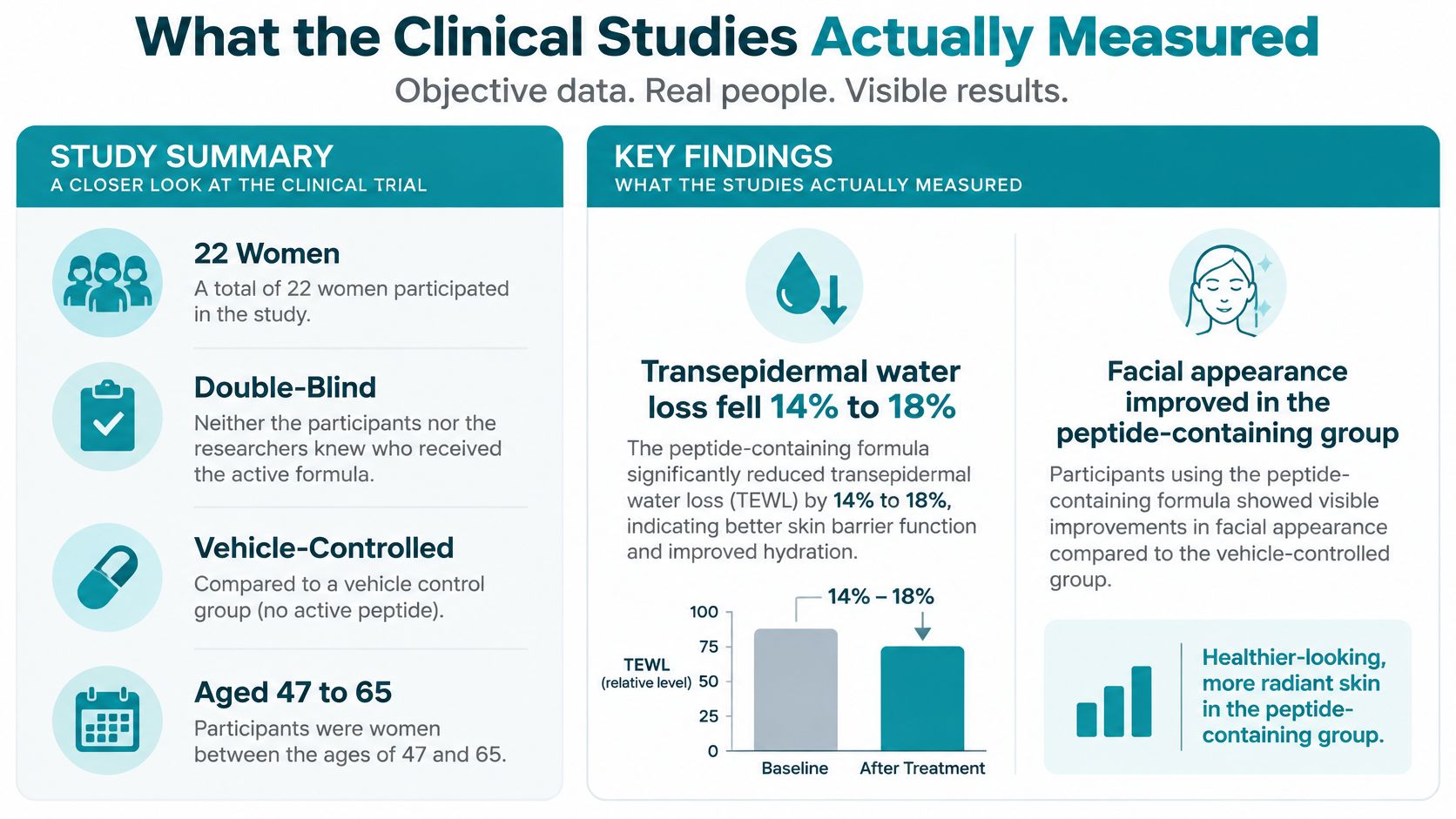
What a water-loss measurement tells you
Transepidermal water loss, usually shortened to TEWL, measures how much water leaves the skin per unit of time. A lower value means the barrier is holding more water in.
That supports a barrier-performance finding, and it sits alongside the hydration and texture improvements participants described. It doesn't establish that the skin produced more collagen, that deep firmness changed, or that the product delivered its peptides into the dermis. Those remain the unproven end of the claim range.
The distinction between measured results and participant impressions matters, too. A TEWL instrument quantifies escaping water; a participant reporting smoother skin describes a perceived experience. Both can be useful, but they answer different questions.
Reliable doesn't necessarily mean dramatic
Statistical significance addresses whether an observed difference is compatible with chance under the study's assumptions. It doesn't tell you whether a friend will notice your skin or whether you'll consider the change worth the cost. A result can be real at the group level and still look subtle in a bathroom mirror.
The vehicle comparison matters because it tests the finished formulation against its own base, which helps separate the product's effect from plain moisturizing. It isn't a head-to-head test of every peptide, moisturizer, or delivery system available.
Keep these limitations attached to the finding:
- Small sample: The participants don't represent every age, skin type, or sensitivity profile.
- Specific formulation: The finding belongs to the tested OS-01 product.
- Limited duration: It doesn't establish indefinite improvement or long-term persistence.
- Different endpoints: Better hydration can't stand in for measured collagen or wrinkle-depth changes.
For a practical trial, use the serum consistently alongside a barrier-supportive moisturizer rather than replacing basic moisturizing care. Match the study's evaluation window and give a new serum the full 12 weeks before deciding whether subtle changes are meaningful.
If you're reading about an individual ingredient, such as how tripeptide-5 is studied in relation to collagen, keep ingredient mechanisms separate from finished-product outcomes. Prefer testing on a formula close to yours, with enough follow-up to assess the claimed result, over dramatic photographs without clear methods.
Choosing a Formulation and Concentration That Works
The finished formula decides results. The word peptide on a label can describe a studied ingredient at a tested level or a trace addition made for marketing, so the concentration and the base carrying it matter more than the name alone.
A booster percentage describes how much of the supplied ingredient solution goes into your base. It works like stock in a soup: a tablespoon tells you the volume added, while the flavor depends on how concentrated the stock was. Two products can list the same addition rate and still deliver different amounts of pure peptide.
Pick a booster by what it is designed to do
| Booster | When it fits |
|---|---|
| Syn-Tacks Peptide Serum Booster | Adding to serums, lotions, or creams when you want a defined addition rate |
| Argireline Amplified | Expression-line appearance as the focus |
| Original Argireline solution | A lower-cost starting point for beginners |
Whichever option you choose, the supplier's stated percentage is the recipe to follow. Confirm whether that rate is measured by weight or by volume before you mix, because the convention changes the arithmetic.
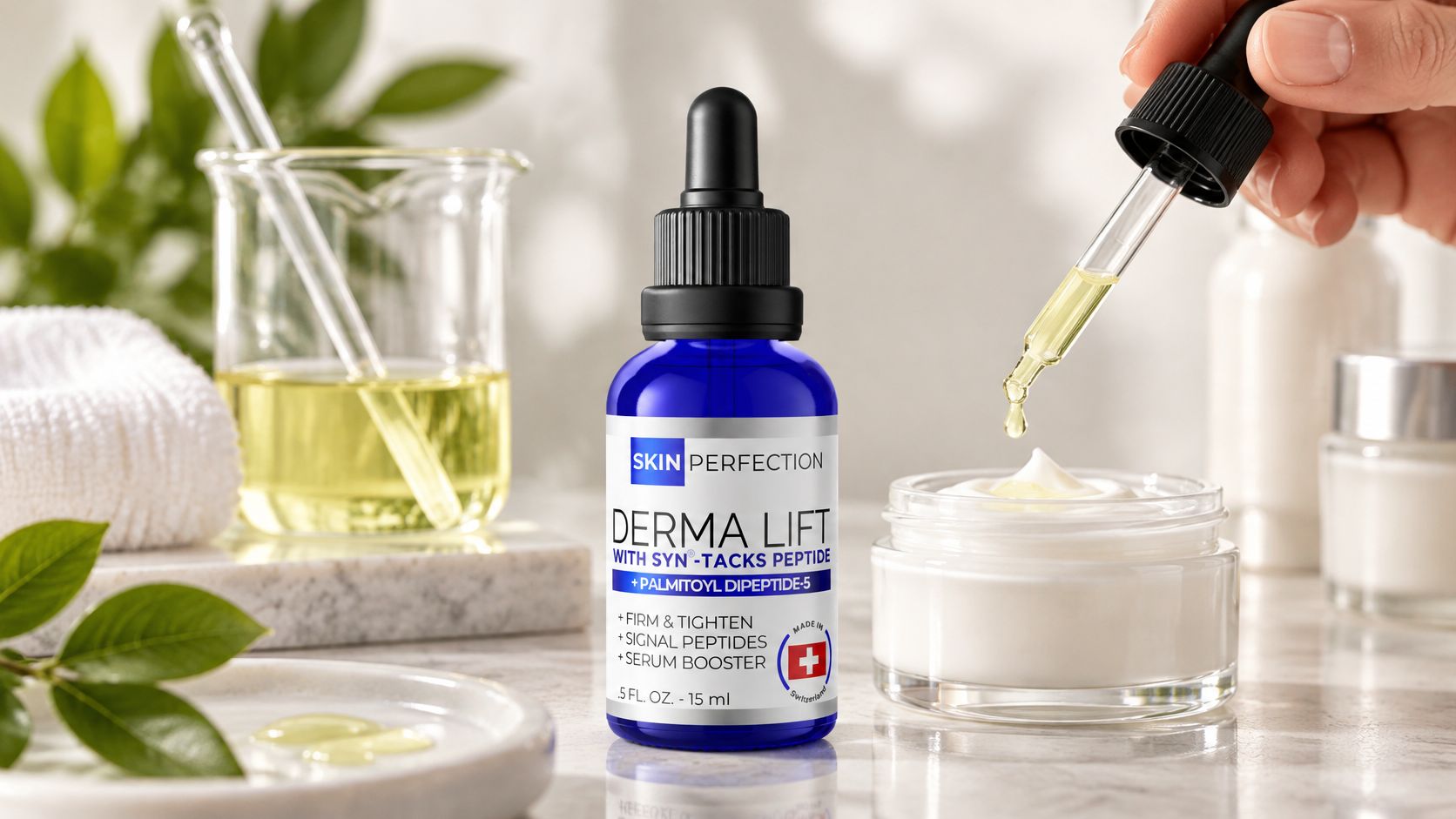
Choose by formulation needs
The tri-peptide booster is intended for incorporation into serums, lotions, or creams. Its defined addition rate suits someone who wants more control than an undisclosed department-store blend provides. That control describes your recipe. Whether the blend you already own was underdosed is a separate question.
The amplified option suits a focus on expression-line appearance. It is designed to be diluted into a compatible base, so add it to a formula rather than applying the concentrate on its own.
The original solution is a lower-cost starting option for beginners or anyone seeking more formula for the money. Sensitive skin still calls for a cautious introduction, since tolerance depends on the person and the base.
Keep clinical findings separate from mixing instructions
A 2025 randomized, double-blind trial available through PubMed Central involving 60 women aged 60-90 found improved hydration and barrier function over 12 weeks; 70% of the treatment group reported better overall appearance versus 42% of controls, while three participants experienced moderate reactions, including rash, pimples, or dry patches. Those findings describe that particular formulation. A booster you mix into your own base at a different rate is a different product.
Formulation rule: The concentration that works is the one the formula supports and your skin tolerates.
For a hypothetical project, say you want to add a 1% booster to a 30 ml moisturizer and assess texture and hydration after six weeks. First confirm that the supplier supports adding it to that base, including its pH and preservation system; then calculate the inclusion using the supplier's stated weight or volume convention.
Use a precision scale when the instructions specify weight. If you work in drops, check your own dropper first: liquid viscosity and dropper design change drop size, so a conversion that held for one liquid may not hold for another.
Don't modify an entire jar because the arithmetic looks easy. Adding a water-based ingredient can alter preservation, stability, and texture; a compatible test batch is more sensible than assuming every finished cream accepts additions.
For further ingredient comparison, the guide to palmitoyl tripeptide-38 can help distinguish peptide identity from blend percentage. More isn't automatically better, especially when a higher addition changes the base that carries it.
Safety Limits and When to Pause Peptide Serums
Peptides aren't automatically gentle. Your tolerance depends on the particular peptide, its concentration, preservatives, solvents, and the condition of your skin when you apply the product.
A cosmetic-peptide safety framework available through PubMed Central describes generally low irritation in the available assessments of commonly reviewed peptides, while emphasizing that safety remains specific to the product and exposure. It also identifies barrier-disrupting situations in which increased permeability can change tolerability.
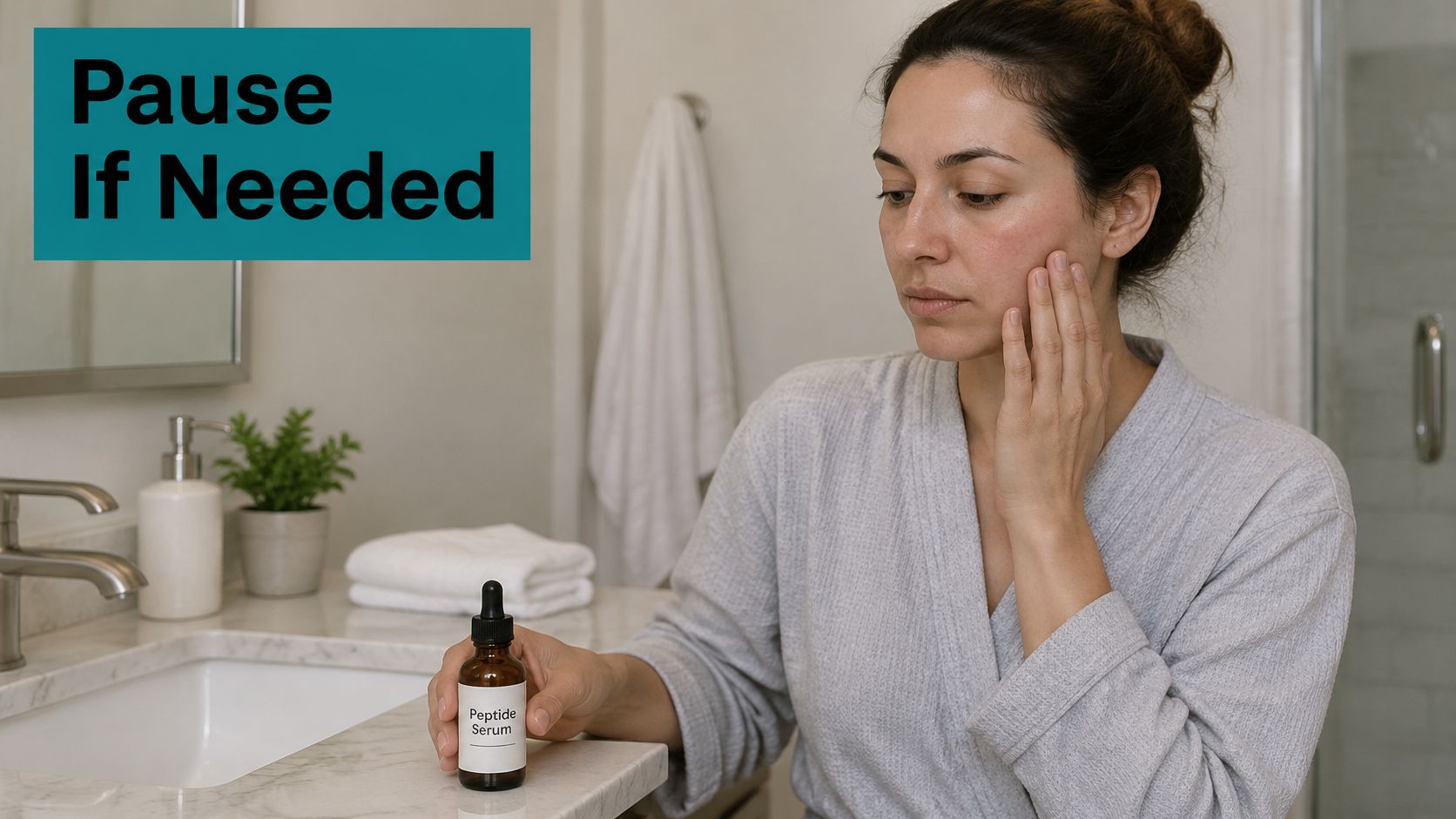
When routine use becomes a different question
Pause new cosmetic actives during an eczema flare, sunburn, or a period of marked skin reactivity. After laser resurfacing, microneedling, chemical peels, or strong exfoliation, use only products your treating professional has cleared for that stage.
A natural, clean, or plant-derived label doesn't establish post-procedure safety. Don't use home microneedling to force a cosmetic serum into the skin.
For reactive complexions, choosing an anti-aging serum for sensitive skin starts with reviewing the whole formula, not just finding a familiar peptide name. Rash, pimples, or dry patches during introduction deserve attention rather than being dismissed as an adjustment you must tolerate.
A cautious home introduction
A small-area test can't rule out allergy or predict every facial reaction, but it can reveal an obvious problem before widespread application.
- Apply a small amount to intact skin on the inner forearm or behind the ear.
- As a cautious home screen, repeat once daily for three to four days.
- Check at 48 hours and after subsequent applications for itching, redness, or swelling.
- If the area stays comfortable, introduce the product to a limited facial area before broader use.
Stop for persistent stinging, spreading redness, swelling, or rash. Seek medical advice for significant or continuing symptoms, and urgent care for breathing difficulty or substantial facial swelling.
Ask your dermatologist or treating clinician about products around a procedure. During pregnancy, have your doctor review the full ingredient list rather than relying on a blanket safety statement about peptides.
Layer Your Peptide Routine and Track Results
Apply leave-on products from thinnest to thickest, with water-based serums before creams and oils. Finish the morning routine with sunscreen, and let product-specific compatibility directions override a generic layering rule.
Where each active goes and how it pairs with peptide serums
| Active | Where It Goes | Pairing Rule | Watch For |
|---|---|---|---|
| Vitamin C serum | After cleansing in the morning | Often compatible; let it dry and check both formulas' directions | Stinging, especially with acidic formulas |
| Niacinamide | Before or after peptides according to texture | Generally compatible | Irritation from the complete combination |
| Hyaluronic acid | On lightly damp skin, before peptides | Compatible; improves the feel of hydration | Tackiness or pilling from excess layers |
| Retinoid | Evening, after the peptide serum dries, if directions permit | Introduce on alternate nights first | Dryness and peeling |
| AHA or BHA exfoliant | Evening, on nights without a retinoid | Avoid stacking strong actives while starting | Increased sensitivity and irritation |
| Moisturizer | Before sunscreen or as the final evening step | Helps retain moisture after serum application | Greasiness or pilling |
| Sunscreen | Final morning skincare step | Use daily; apply separately rather than blending into serum | Incomplete coverage or missed reapplication |
Compatibility isn't universal chemical permission. A copper-peptide formula, an acidic vitamin C serum, and an exfoliant may carry different manufacturer directions, so separating them into different routines can be simpler than trying to layer everything.
The common mistake is introducing a retinoid or exfoliant at the same time as a new peptide serum. If your skin becomes uncomfortable, you won't know which product, dose, or combination caused it.
A straightforward morning and evening routine
Introduce one new active at a time, leaving one to two weeks between additions as a practical observation period. Keep the cleanser and moisturizer familiar while you assess the newcomer.
Morning
- Cleanse gently, without scrubbing.
- Apply vitamin C if you already use and tolerate it.
- Apply two to three drops of your finished peptide serum, or a correctly prepared booster-containing serum, unless its directions specify otherwise.
- Apply moisturizer.
- Finish with sunscreen, using its labeled application amount.
Evening
- Cleanse to remove sunscreen and daily residue.
- Apply the peptide serum to dry skin, unless its directions recommend otherwise.
- Use a retinoid on alternate nights initially, if already tolerated and compatible. Skip it while you're new to actives.
- Apply moisturizer.
For texture-specific examples, the guide to how to layer skincare serums can help you simplify a routine that pills or feels overloaded. You don't need a separate serum for every ingredient.
Adapt the base to your goal
For dryness and uneven-feeling texture, choose a hydrating serum or moisturizer as the foundation. If you're using a booster, confirm that the base accepts it rather than assuming any watery serum is compatible.
For expression-line appearance, a compatible lightweight serum or eye-area product may be practical. Only add a booster to an eye cream when its supplier supports that use, and keep it away from the lash line and eyes.
A dedicated daytime peptide serum and a booster-containing night moisturizer are another possible arrangement. Start with just one, however, so you can judge its contribution without doubling your variables.
Skin Perfection's cosmetic approach stays focused on beautifying skin and appearance-related descriptions, consistent with FDA cosmetic-labeling guidance and Etsy's medical-claims policy. A cosmetic listing isn't evidence of therapeutic performance or regulatory endorsement.
Keep a useful results log
Commit to a six-week observation period with one peptide product. Photograph the same area weekly in the same light, at the same distance, without changing filters or facial expression.
Note morning tightness, softness, visible flaking, application comfort, and whether makeup sits differently. Judge hydration and texture at week six, then reassess firmness or line appearance at week twelve without treating that date as a guaranteed result.
If nothing meaningful changes, review the formula, concentration, and consistency of use before buying a stronger version. Pick one product, patch-test it, and start your log this week.
Skin Perfection offers skincare products and lotion-making supplies for ready-made routines and carefully planned custom formulations. Visit Skin Perfection to compare peptide options and recommended mixing directions, then choose one product that fits your hydration and appearance goals.