

 Buy with Prime



Cosmetic butters aren't equally stable: a comparative study of cosmetic butter oxidation measured oxidation times of 77–229 minutes for some butters versus 430–605 minutes for others under its test conditions. Those aren't shelf-life predictions, but they undermine a common purchasing shortcut: a solid, luxurious-feeling fat isn't automatically a durable formulation ingredient.
Choosing butters and oils requires more than matching a texture to a skin type. A useful assessment combines fatty-acid composition, melting behavior, finished-formula tolerance, oxidation testing, and documented sourcing. Each answers a different question, and none can substitute for all the others.
Table of Contents
- Butters and Oils at a Glance
- How Butters and Oils Differ in Structure
- Shea, Cocoa, Mango and Kokum Butter Profiles
- Carrier Oil Profiles From Olive to Jojoba
- Comedogenic Ratings and Skin Type Fit
- Pairing Butters and Oils With Peptides and Vitamins
- Oxidation, Shelf Life and Quality Checks
- Verify Sourcing Before You Choose a Butter or Oil
Butters and Oils at a Glance
Comedogenic ratings span 0 to 4 across this ingredient guide, while melting behavior ranges from pourable oils to firm butters. Use both as screening tools: the rating can narrow candidates for skin type, and the physical form can help set handling and structure expectations.
Butters and oils quick-reference
| Ingredient | Category | Comedogenic (0-5) | Melts or pours | Skin type fit |
|---|---|---|---|---|
| Shea butter | Butter | 0-2 | Solid, melts about 32-48 °C | Dry, mature, sensitive |
| Cocoa butter | Butter | 4 | Firm solid; softens with skin warmth | Dry skin, body care, lip balms |
| Mango butter | Butter | 0-4 | Solid, melts near skin temperature | Dry skin, body care |
| Kokum butter | Butter | 0-2 | Hard solid; requires melting for incorporation | Dry skin, firm balms and sticks |
| Coconut oil | Oil, solid when cool | 4 | Solid in cool conditions; liquid when warm | Body and dry skin; avoid on acne-prone face |
| Jojoba oil | Liquid wax ester | 2 | Liquid | Normal, combination, oily with light use |
| Argan oil | Oil | 0 | Liquid | Oily, combination, acne-prone |
| Sweet almond oil | Oil | 2 | Liquid | Normal, dry; check nut allergy |
| Rosehip seed oil | Oil | 1 | Liquid | Dry, mature; oxidation-sensitive |
| Grapeseed oil | Oil | 1 | Liquid, light | Oily, combination |
| Sunflower oil, standard | Oil | 0 | Liquid | Sensitive, dry |
| Olive oil | Oil | 2 | Liquid, heavy | Dry, mature, body care |
| Avocado oil | Oil | 3 | Liquid, heavy | Dry skin, body care |
Ratings are approximate screening conventions, and published charts vary, especially for mango and kokum. Use a rating as a first filter, then test the finished formula. Scores from 0 to 1 can be starting points for oily or acne-prone skin; scores of 2 to 3 warrant closer attention to concentration and application; scores of 4 or above may point toward body-care use rather than facial leave-ons.
Read the columns together
The table groups ingredients by handling behavior: room-temperature solid butters, coconut oil that changes state in cool conditions, and pourable oils. Jojoba pours like an oil, though its wax-ester chemistry sets it apart from the other entries.
Skin-type fit is a starting formulation direction. A rich oil may suit a body lotion yet feel excessive in an undiluted facial application. A light oil may spread readily while requiring closer attention to oxidation control.
- For structure, use the butter's stated melting range and hardness to guide handling.
- For finish, compare spread, residual film, and drag in the actual base.
- For purchasing, request the lot's fatty-acid profile rather than relying on an ingredient-name average.
Fatty-acid ranges shift with crop, region, processing, and supplier. The actual lot's certificate of analysis takes precedence over a generic composition table, but it does not establish skin tolerance or finished-product shelf life. A candidate's fatty-acid profile and oxidation sensitivity therefore need to be considered alongside its texture and intended skin-type fit.
How Butters and Oils Differ in Structure
A plant butter is a fat that's solid or semi-solid at ordinary room temperature, commonly obtained from nuts, seeds, or kernels. A conventional plant oil is generally liquid under the same conditions and often contains a larger proportion of unsaturated fatty acids. Jojoba is different again, consisting predominantly of liquid wax esters rather than triglycerides.
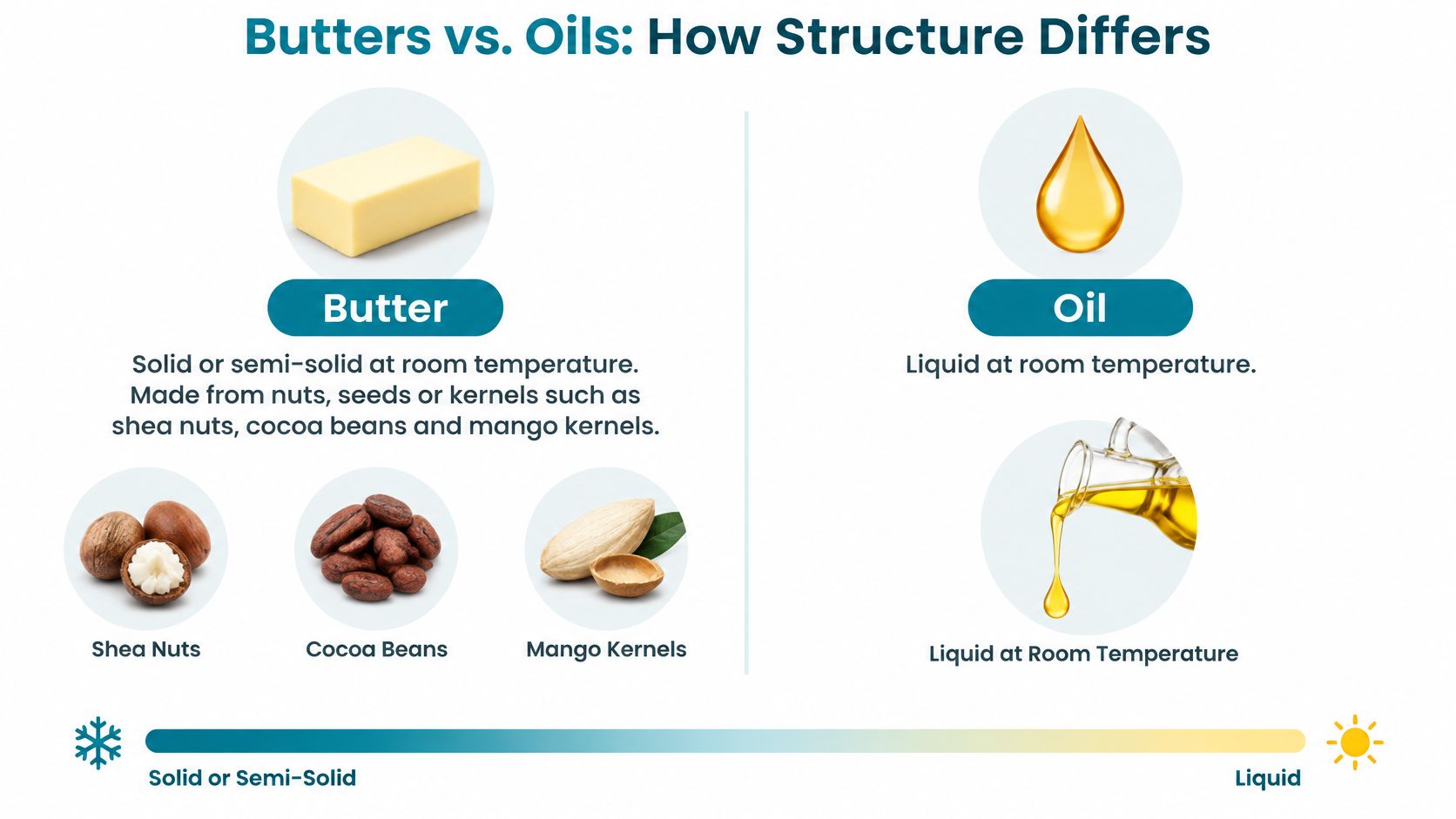
More saturated, stearic-rich compositions generally support firmness. Additional double bonds increase susceptibility to oxidation, but don't independently determine whether a finished product feels light or heavy.
The academic review of shea butter composition and processing reports approximately 45.77% oleic acid and 43.53% stearic acid in one crude-butter dataset, alongside broader unrefined-material ranges of 32–62% oleic and 25–50% stearic. It also reports practical melting intervals around 32–48 °C, illustrating why an ingredient name alone can't specify processing behavior.
Structure isn't just composition
Polymorphism means that the fat can form different crystal arrangements. Those arrangements affect graininess, hardness, and how a cooled balm spreads, even when its ingredient list hasn't changed.
Iodine value indicates unsaturation; it doesn't measure remaining shelf life. Antioxidants, previous handling, packaging, and the finished formulation still matter.
Bench rule: Choose a butter when you need body and a more substantial film. Choose an oil when you need flow and spread, then verify the finish rather than predicting it from unsaturation alone.
Shea, Cocoa, Mango and Kokum Butter Profiles
A butter's role becomes clearer when origin, composition, use, and limitations are considered together. Substituting one butter for another by weight may preserve the ingredient count while changing the product's hardness, gloss, and cooling requirements.
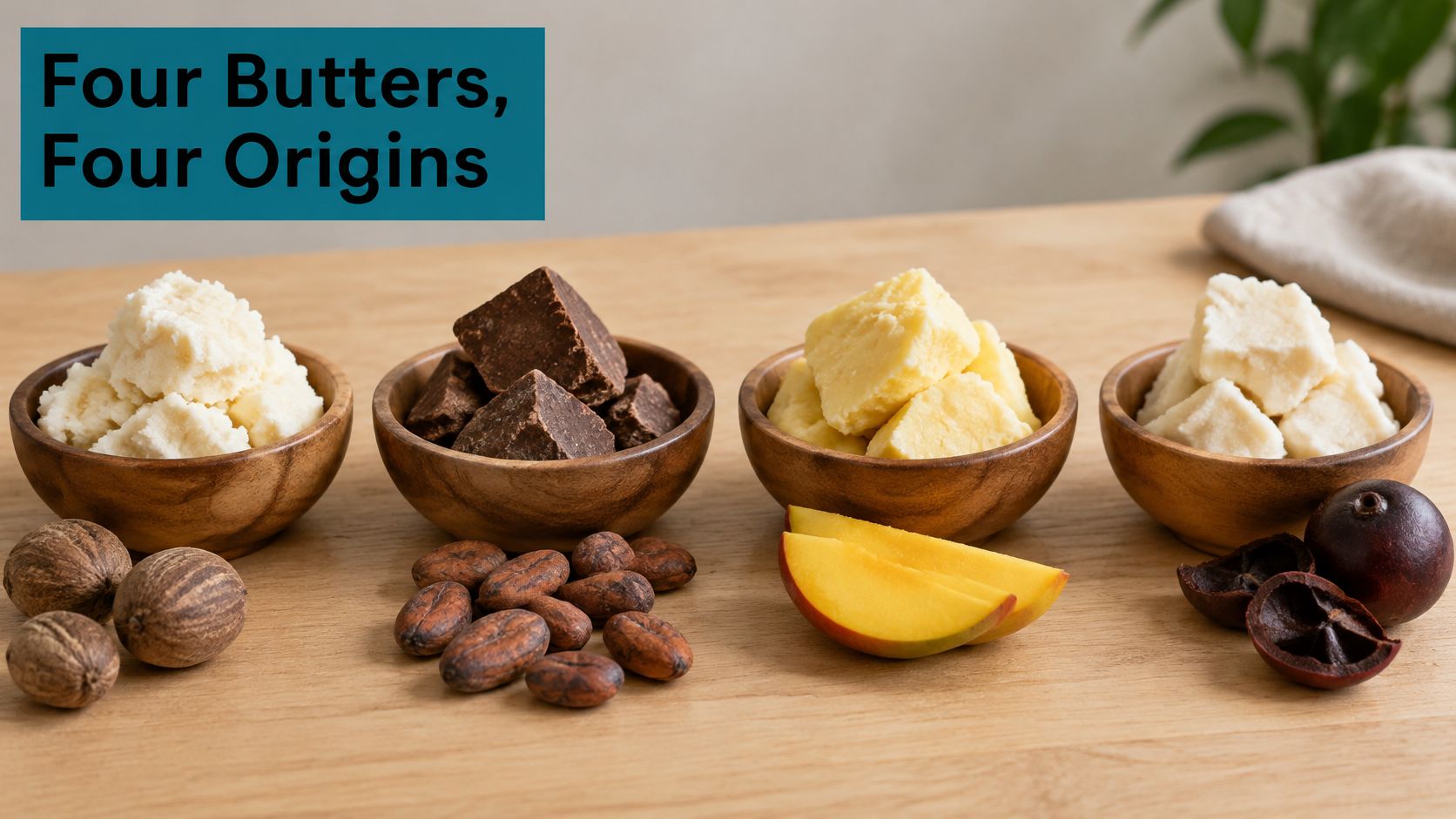
Shea butter
Origin and profile. Shea comes from the nut of Vitellaria paradoxa, associated with the West African savanna belt and harvesting networks that can include women's cooperatives. Its combination of oleic and stearic components explains its balance of emollient spread and structure.
DIY use. Use shea as the structural base of a body butter, adjusting the liquid-oil fraction to control scoopability. Higher-melting stearin fractions can increase firmness, while olein fractions increase fluidity.
Edge case. Unrefined shea can contribute noticeable scent and color; refined material is usually more neutral. That distinction matters in fragrance-free-looking products, pale emulsions, and formulas where a botanical odor would compete with other ingredients.
Shea is nut-derived, so don't treat a generic skin-type recommendation as allergy clearance. Ask for processing and allergen documentation, and seek professional guidance where a known allergy is involved.
Cocoa butter
Cocoa butter comes from Theobroma cacao beans. Its characteristic firmness and crystalline structure make it useful when a balm needs a polished surface, a substantial film, or a distinct snap.
DIY use. Consider it for lip balms and firm body butters rather than automatically selecting it for a facial leave-on. Its relatively high screening rating makes facial use a more cautious formulation decision.
Edge case. More cocoa butter doesn't automatically mean a better balm. It can increase drag, brittleness, and the difficulty of dispensing a product from a narrow opening.
Unrefined material can also bring a recognizable cocoa aroma. Evaluate it without added fragrance before deciding whether that scent suits the intended product.
Mango butter
Origin and profile. Mango butter is obtained from the kernel of Mangifera indica. Its stearic-and-oleic pattern makes it a candidate for firm, creamy textures without assuming that it behaves identically to shea.
DIY use. Test it in a hand butter or body balm when you want structure but prefer a different sensory profile from cocoa butter. Compare both immediate spread and the residual film after the product settles.
Edge case. Published comedogenic charts disagree substantially about mango butter. A low number copied from one supplier doesn't resolve that disagreement or establish suitability for every facial formula.
Kokum butter
Kokum butter comes from Garcinia indica seed and is generally selected for its firm, stearic-rich character. It can provide structure where a softer butter would leave a stick or balm too easily deformed.
DIY use. Use it as a firmness contributor in a stick, then balance it with a pourable carrier. Check application drag as carefully as standing hardness.
Edge case. Excessive firmness can produce a brittle product that resists spreading. Correct that through controlled trial batches, not by repeatedly reheating an entire production batch.
For a practical starting process, the body butter making guide provides a useful companion to ingredient selection. Keep a batch record of heating, cooling, mixing, and final texture so that a successful result can be reproduced.
Carrier Oil Profiles From Olive to Jojoba
Group carrier oils by chemistry before comparing marketing descriptions. Oleic-rich, linoleic-rich, wax-ester, and saturated materials create different formulation opportunities, and no category alone establishes a finished product's sensory feel or storage life.
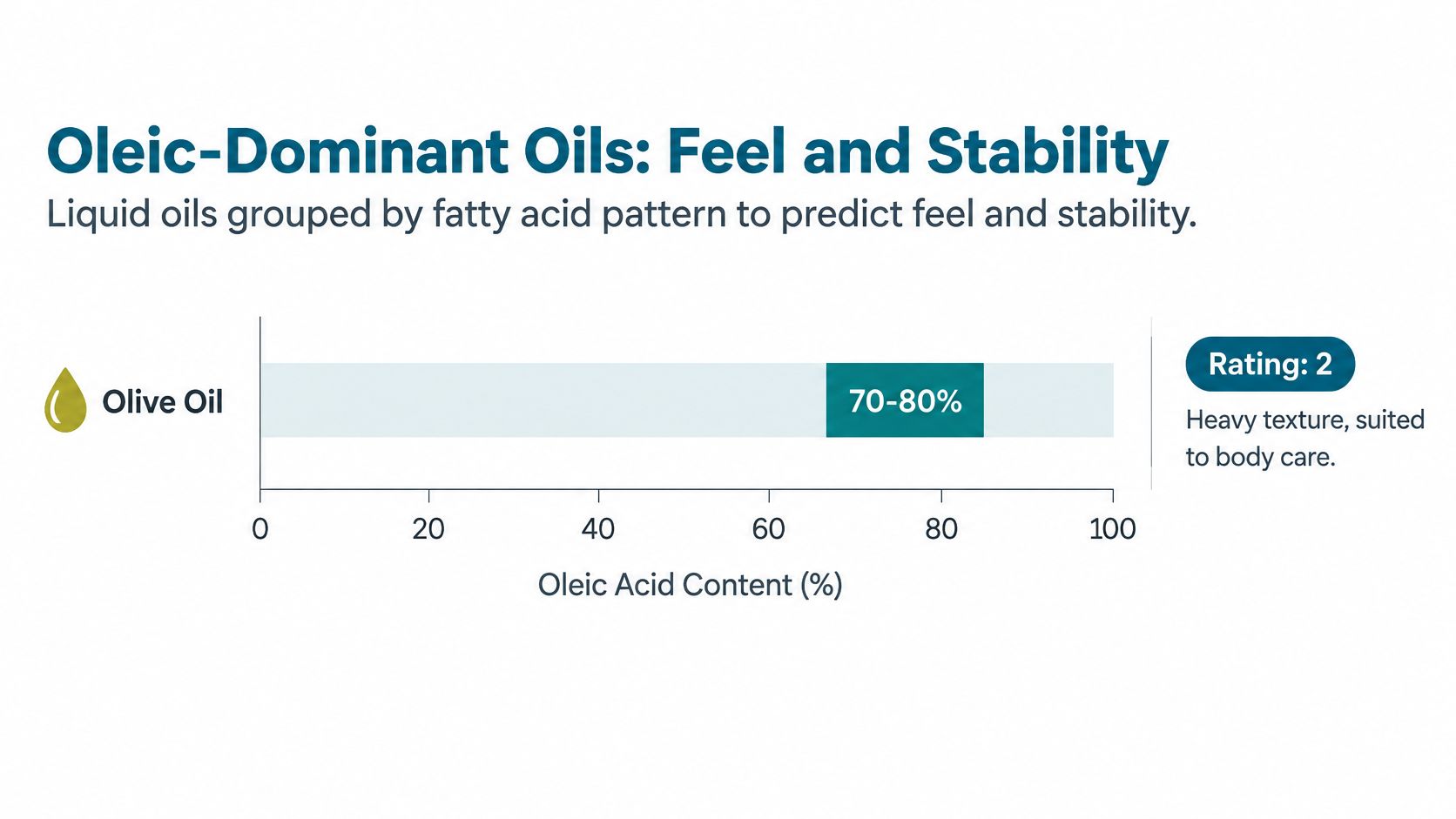
Treat the olive illustration as a general orientation for the oleic-rich group. Request the supplier's composition results before using an illustrated range in a technical document.
Oleic-rich carriers
Olive oil comes from the olive fruit and is commonly oleic-dominant. Its substantial residual feel makes it a practical body-oil or rich-lotion candidate, especially when a lingering film is desirable.
Avocado oil comes from the fruit pulp and also belongs in the oleic-rich group. Consider it for a rich body emulsion, and test color, odor, and finish because refining can materially change those characteristics.
Sweet almond oil, from Prunus dulcis, combines an oleic-dominant profile with a meaningful linoleic component. It provides useful slip in body oils and massage-style blends; its nut origin requires a separate allergen assessment.
Argan oil, from Argania spinosa and associated with Moroccan production, has a more balanced oleic-and-linoleic profile than strongly oleic-dominant carriers. That balance suits light facial oil formulas where a moderate finished feel fits the brief.
Fixed fatty-acid percentages need a compositional source or lot certificate before they go into a document. A cultivar, refining process, or supplier change can make a familiar ingredient behave differently at the bench.
Linoleic-rich carriers
Grapeseed, standard sunflower, and rosehip seed oils deserve more attention to oxidation management than their light or elegant sensory descriptions might suggest.
- Grapeseed oil comes from grape seeds, commonly linked to winemaking by-products. Its linoleic-rich composition and light spread make it a useful candidate for combination-skin emulsions.
- Standard sunflower oil is generally linoleic-rich, and high-oleic sunflower is a distinct purchasing choice. Specify the grade rather than accepting sunflower as a complete technical description.
- Rosehip seed oil can contain substantial linoleic and linolenic components. Use it in dry-skin facial oil trials with deliberate packaging and antioxidant assessment; treat its botanical reputation as a naming cue and let packaged testing establish durability.
The sunflower seed oil guide offers additional ingredient context. For procurement, ask the supplier to distinguish conventional and high-oleic material in writing.
Rosehip naming needs the same care. Confirm the botanical identity, plant part, extraction method, and whether the material is seed oil or another rosehip-derived preparation.
Jojoba and coconut
Jojoba, from Simmondsia chinensis, is a pourable wax-ester material, so its chemistry differs from conventional triglyceride carriers. It works as a light facial carrier or as part of an emulsion's oil phase; check solubility separately, since easy spreading alongside an aqueous peptide concentrate leaves that question open.
Coconut oil is a more saturated carrier, characterized by its lauric component and cool-temperature solidification. Consider it for body and hair-care products where that temperature-dependent texture is acceptable.
Whole coconut oil and fractionated coconut materials serve different formulation roles. Ask which material you're buying, because fractionation changes composition, consistency, and the part it can play in a formula.
Food-use discussions require a separate frame: Pumpernickel Health Foods' guide to training fuel covers dietary context for coconut oil, and topical performance is a different question. Keep nutritional claims out of cosmetic descriptions.
Cold-pressed describes a processing method. Test cold-pressed oils in the packaged formula to check oxidation; the fatty-acid profile predicts tendencies, and the packaged result confirms them.
Comedogenic Ratings and Skin Type Fit
Use the rating as a filter for facial products. It sorts carriers by relative pore-clogging potential under a shared convention; finish, irritation risk, oxidation state and sourcing quality still need separate checks.
The commonly circulated Fulton-style scale is a convention for ranking that potential. Published numbers can vary by source and crop, so read each value as a position in a range for comparison, then confirm against the finished formula and the user.
Use a screening ceiling
Rating ceilings and carriers by skin type
| Skin type | Rating ceiling | Suitable carriers | Use with caution |
|---|---|---|---|
| Oily or acne-prone | 0-1 | Argan, grapeseed, sunflower, rosehip | Coconut, cocoa butter, avocado |
| Combination | 0-2 | Jojoba, grapeseed, argan, sweet almond | Coconut, cocoa butter |
| Normal | 0-2 | Jojoba, sweet almond, argan, olive in body care | Cocoa butter on the face |
| Dry | 0-3 | Shea, olive, avocado, sweet almond | Coconut on the face if breakouts occur |
| Mature | 0-2 | Shea, rosehip, jojoba | Heavy butters under daytime makeup |
| Sensitive | 0-1 | Sunflower, argan, grapeseed | Any nut-derived carrier until appropriately assessed |
Treat these ceilings as working selection limits. Irritation, allergy, oxidation products and individual response sit outside the score, and a higher-listed material can still fit a body formula when exposure is low.
Mature skin spans more than one oil-production pattern. A person can have mature, oily skin or mature, dry skin, so choose texture according to current skin behavior and treat age as a weak predictor.
For another commonly discussed carrier, the guide to whether squalane is comedogenic helps extend the comparison beyond conventional seed oils.
Separate tolerance from pore-clogging potential
A low score still leaves fragrance, botanical constituents, oxidation products and individual allergens to be assessed on their own.
Concentration changes exposure. An oil used as the main component of a facial blend creates a different exposure from the same material used sparingly inside a larger emulsion.
- Check the complete formula, including fragrance, preservatives, extracts, and emulsifiers.
- Assess the application, including amount, frequency, facial versus body use, and products layered over it.
- Introduce changes separately, so an unwanted response can be traced more easily.
For broader routine considerations, dry skin advice from Vitamin Planet provides context beyond carrier selection. Oils contribute emollience, but an oil-only formula and a water-containing moisturizer aren't functionally identical.
Before facial use, try a small amount of the finished product on the inner forearm or behind the ear and observe for an unwanted response. A home spot test has narrow scope: it can reveal an immediate reaction, while longer-term pore behavior still needs observation. Stop use if irritation develops and seek appropriate advice when needed.
Pairing Butters and Oils With Peptides and Vitamins
Check the supplier's solubility data first, then assign the active to the aqueous or oil phase. Hyaluronic acid, niacinamide, ascorbic acid, and many commercial peptide solutions belong in an aqueous system; tocopherol and retinyl palmitate belong in the oil phase. The label's benefit category comes second to the shipped form, because a dispersion, powder, or ester can behave differently in the same formula.
Actives, phase and carrier pairings
| Active | Phase | Carrier pairings | Watch for |
|---|---|---|---|
| Palmitoyl tripeptide-1 | Supplier's aqueous dispersion or serum system | Jojoba or grapeseed in a separate layer or emulsion | Confirm supplied form and solubility; add at approved cool-down conditions |
| Hyaluronic acid | Water phase | Light oils in an emulsion | Hydrate fully using the grade-specific procedure |
| Niacinamide | Water phase | Argan, grapeseed in an emulsion | Check pH and processing compatibility |
| Ascorbic acid, vitamin C | Water phase, acidic system | Low-oil aqueous serum or emulsion | Oxidation, light exposure, and pH |
| Ascorbyl palmitate | Oil phase | Rosehip, argan, sunflower | Confirm dissolution and treat it as a separate vitamin C ester |
| Tocopherol, vitamin E | Oil phase | Especially rosehip and grapeseed | Antioxidant support doesn't replace stability testing |
| Retinyl palmitate | Oil phase | Jojoba, argan, sunflower | Light sensitivity and supplier-specified use conditions |
Compatibility comes before pairing
Palmitoylated peptides are supplied in different forms: isolated molecules, dispersions, and finished serum-type bases can call for different handling. The commercial dispersion determines whether the peptide enters an aqueous system or stays in a concentrate added during cool-down.
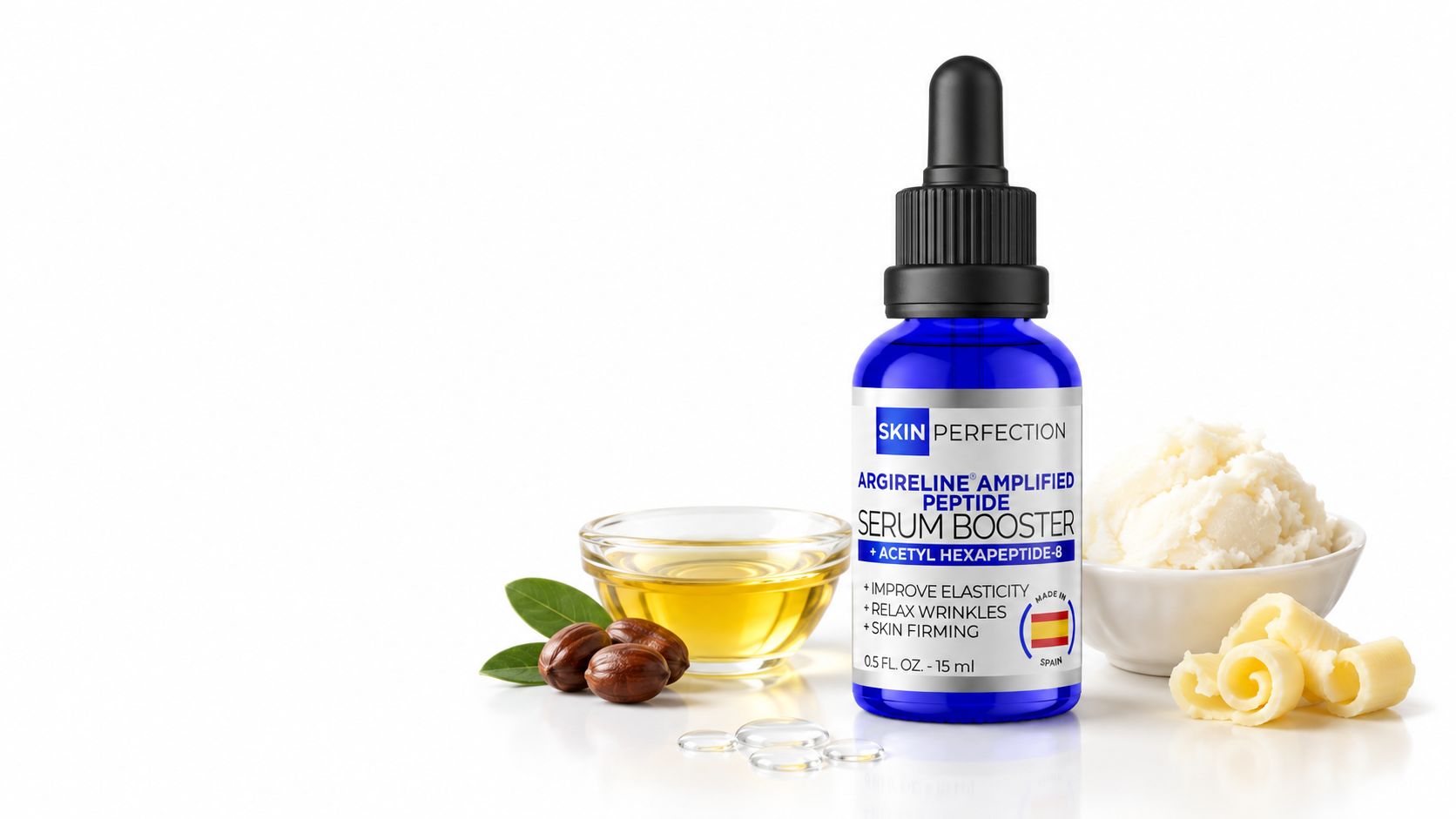
For a factual example, use the Argireline Amplified Peptide Serum Booster listing as the reference for supplied form, handling, and dilution status before bench work.
Use the supplier's heat, pH, and dosage instructions; a universal cool-down temperature can under- or over-expose the active. The compatibility notes for copper peptides with vitamin C add context for actives whose performance depends on pH and oxidation exposure.
Formulation check: Aqueous actives need a compatible water phase or a properly designed emulsion; an anhydrous butter-oil base cannot supply that phase on its own.
Inspect trial batches for separation, odor shift, and phase clarity, then confirm preservation and stability with the appropriate test plan. A uniform appearance after mixing is only an early screen; preservation efficacy and longer-term stability need their own checks.
Oxidation, Shelf Life and Quality Checks
Unsaturated lipids react with oxygen, and light and heat accelerate the deterioration. The rate depends on composition, handling, packaging, and the other ingredients present, which is why two oils with similar textures can age very differently: the unsaturated fatty acid profile that shapes skin feel also sets oxidation vulnerability.
Peroxide value, or PV, reflects hydroperoxides associated with early oxidation. Acid value, or AV, reflects free fatty acids, including those released through hydrolysis, so it tracks a separate failure pathway from peroxide formation.
The Codex Standard for Named Vegetable Oils specifies maximum AVs of 0.6 mg KOH/g for refined oils and 4.0 mg KOH/g for cold-pressed or virgin oils, with PV limits up to 10 milliequivalents of active oxygen/kg for refined oils and 15 milliequivalents/kg for cold-pressed or virgin oils. These figures give the formulator reference specifications for relevant oils; a finished cosmetic still needs its own stability evidence.
Build an incoming-lot routine
- Record the certificate of analysis. Match the supplier's document to the received lot and retain the manufacturing, receipt, and opening information.
- Test PV and AV. Use a laboratory working with recognized AOCS or ISO methods, and keep methods consistent when comparing results.
- Set acceptance criteria. Compare relevant results with the applicable specification, then consider tighter internal requirements for highly unsaturated, odor-sensitive, or facial leave-on materials.
- Control storage. Use sealed, light-protective containers with minimal practical headspace at a stable temperature. Avoid repeatedly warming the entire stock container to make a small batch.
A single acceptable result establishes a baseline. Durability has to be demonstrated over time: compare retained samples and test the actual package, because an ingredient in a sealed bulk drum experiences different conditions from a filled consumer jar.
Interpret symptoms without guessing
Oxidation and quality symptoms, causes and actions
| Symptom | Likely cause | Action |
|---|---|---|
| Rancid, crayon, or paint-like smell | Advanced oxidation of unsaturated fats | Reject or discard the lot; don't mask with fragrance |
| Darker color with stronger odor | Oxygen and light exposure, or another quality change | Run PV and AV; investigate the lot |
| Rising peroxide value between tests | Early hydroperoxide formation | Compare with acceptance criteria; tighten storage |
| Rising acid value | Hydrolysis releasing free fatty acids | Check moisture exposure and handling; assess replacement |
| Grainy or sandy butter texture | Crystal change from temperature cycling | Re-melt gently if appropriate, validate cooling, and retest hardness |
| Oily film or separation in a finished balm | Crystal-network or melting mismatch; emulsion failure if water is present | Rebalance the structural fats or emulsifier system and retest |
Diagnose graininess through crystallization behaviour before changing the cooling step. A grainy butter often reflects a crystal change from temperature cycling, while a smooth product can still carry unacceptable chemical deterioration, so texture cannot clear or condemn a lot on its own. Once crystallization is confirmed as the cause, establish a cooling and mixing procedure for the particular butter blend and challenge it through temperature cycling before scale-up.
Treat odor and color changes as warning signs that trigger testing. Hydroperoxides also decompose as oxidation progresses, so a low PV cannot clear an old, suspicious-smelling oil on its own.
Add an antioxidant system only after compatibility, regulatory, and stability assessment. Tocopherol can support oxidation control within a formula built on sound raw materials, protective packaging, and, for water-containing products, adequate preservation.
Verify Sourcing Before You Choose a Butter or Oil
Industry reporting summarized in the global shea butter market report estimates that approximately 8 million shea trees are lost annually to encroachment and deforestation. Shea's dependence on wild harvesting makes land use and harvesting livelihoods part of the ingredient decision, not a separate marketing topic.
The same industry report discusses the EU Deforestation Regulation's coverage of palm oil, cocoa, coffee, soy, cattle, timber, and rubber, alongside increasing buyer requests for evidence concerning other cosmetic ingredients. A buyer's request for shea or argan documentation shouldn't be confused with a statement that those ingredients automatically fall within the same legal commodity scope.
Ask what the claim actually covers
Origin traceability should identify more than the country printed on an invoice. District, cooperative, processor, and chain-of-custody information help a buyer understand where the material entered the supply chain.
Producer-group verification and worker-benefit records answer different questions from a certificate of analysis. Chemical conformity doesn't establish fair payment, and a social claim doesn't establish acceptable oxidation quality.
- Land-use evidence should relate to the ingredient's actual production or collection area.
- Mass-balance documentation generally accounts for qualifying material within a mixed supply system.
- Segregated supply documentation supports a different claim about physical separation and traceability.
Don't present mass balance as proof that the specific contents of a bottle came from a physically segregated source. Ask the supplier to explain the accounting model in plain language.
Replacing wild-harvested material with plantation production can also affect harvesting households' income. Compare ingredient-specific environmental and livelihood risks instead of assuming that a different crop or production system is automatically preferable.
Make the purchase decision document-led
- Request the lot certificate. Ask for PV, AV, and fatty-acid composition, plus the test methods used.
- Get origin and supply model in writing. Identify the processor, production region, and any producer-group relationship.
- Ask for ingredient-specific deforestation evidence. Check its scope, traceability model, and relevance to the material you're purchasing.
- Match the material to the formula. Confirm structural performance, oxidation requirements, intended skin-type positioning, and packaging before committing to volume.
For larger purchases, the bulk jojoba buying guide provides a relevant purchasing context. Order a representative sample, retain it, and compare the delivered lot against both documentation and your bench assessment.
The strongest choice isn't necessarily the most fashionable butter or the oil with the lowest published rating. It's the material whose composition, handling requirements, performance, and supply history you can explain and verify.
Skin Perfection offers skincare products that beautify the skin and lotion-making supplies for custom formulations. Visit Skin Perfection to explore ready-made skincare and formulation ingredients, then build your selection around the carrier profile, compatibility, and quality checks your formula needs.