

 Buy with Prime



The popular advice says to buy the serum with the most peptides at the highest percentage. That's a poor way to choose. A peptide serum for mature skin can make skin look smoother and better moisturized, but different peptides do different jobs, and a long ingredient list doesn't tell you what was tested. You'll make a better decision if you ask three calmer questions. Which peptide is it, what outcome did researchers measure, and how long did people use it?
Table of Contents
- Why Peptide Serums Are Gaining Ground in Mature Skin Care
- How Peptides Signal Mature Skin to Rebuild
- Comparing Signal, Carrier and Relaxing Peptide Types
- Formulation Details That Decide Whether a Serum Delivers
- Building a Peptide Serum Into Your Mature Skin Routine
- Reading the Signs of Efficacy Over Weeks and Months
- Choosing a Peptide Serum and Taking the First Step
Why Peptide Serums Are Gaining Ground in Mature Skin Care
You wash your face in the morning and lean closer to the mirror. The lines beside your mouth look deeper than they did last winter. Your cheeks feel dry by midday, even after moisturizer, and foundation settles into texture you didn't notice before.
That moment is why many adults start reading serum labels. They aren't looking for a medical treatment. They're looking for a cosmetic product that helps skin look smoother, firmer, and more even in the mirror.
Peptide serums aren't a sudden trend. Peptide actives first entered cosmetics in the 1990s, and researchers identified the pentapeptide KTTKS in 1993 from type I procollagen for its ability to stimulate extracellular matrix production, as summarized in a review of peptide development in cosmetics. That discovery helped move the category beyond simple surface moisturizing toward formulas meant to support the look of firmness and smoothness.
Why Mature Skin Became the Focus
Mature skin changes in ways that make that goal understandable. Skin can feel drier and thinner. Fine lines, loss of bounce, and rougher texture become more visible, so readers often want both hydration and a smoother appearance.
If you're building the basics around a serum, these skincare tips for mature skin from Ideal Face & Body give useful context on the cleansing, moisturizing, and sun protection habits that sit around any active product. A serum works inside that routine. It doesn't replace it.
A peptide serum is best judged as one cosmetic step that beautifies the skin's appearance, not as a product that fixes or cures an underlying condition.
Keep that boundary in mind as you read labels. It'll help you separate a reasonable cosmetic claim, such as skin looks smoother, from language that promises more than a cosmetic should.
How Peptides Signal Mature Skin to Rebuild
Think of your skin as a house that's still occupied but maintained more slowly than it used to be. The structure is there. The crew that maintains it just gets fewer clear instructions, and the work takes longer.
Peptides are short chains of amino acids. Amino acids are the small building units that make up larger proteins, and proteins such as collagen help give skin its structure. In this analogy, a peptide isn't a new wall. It's a short written message.
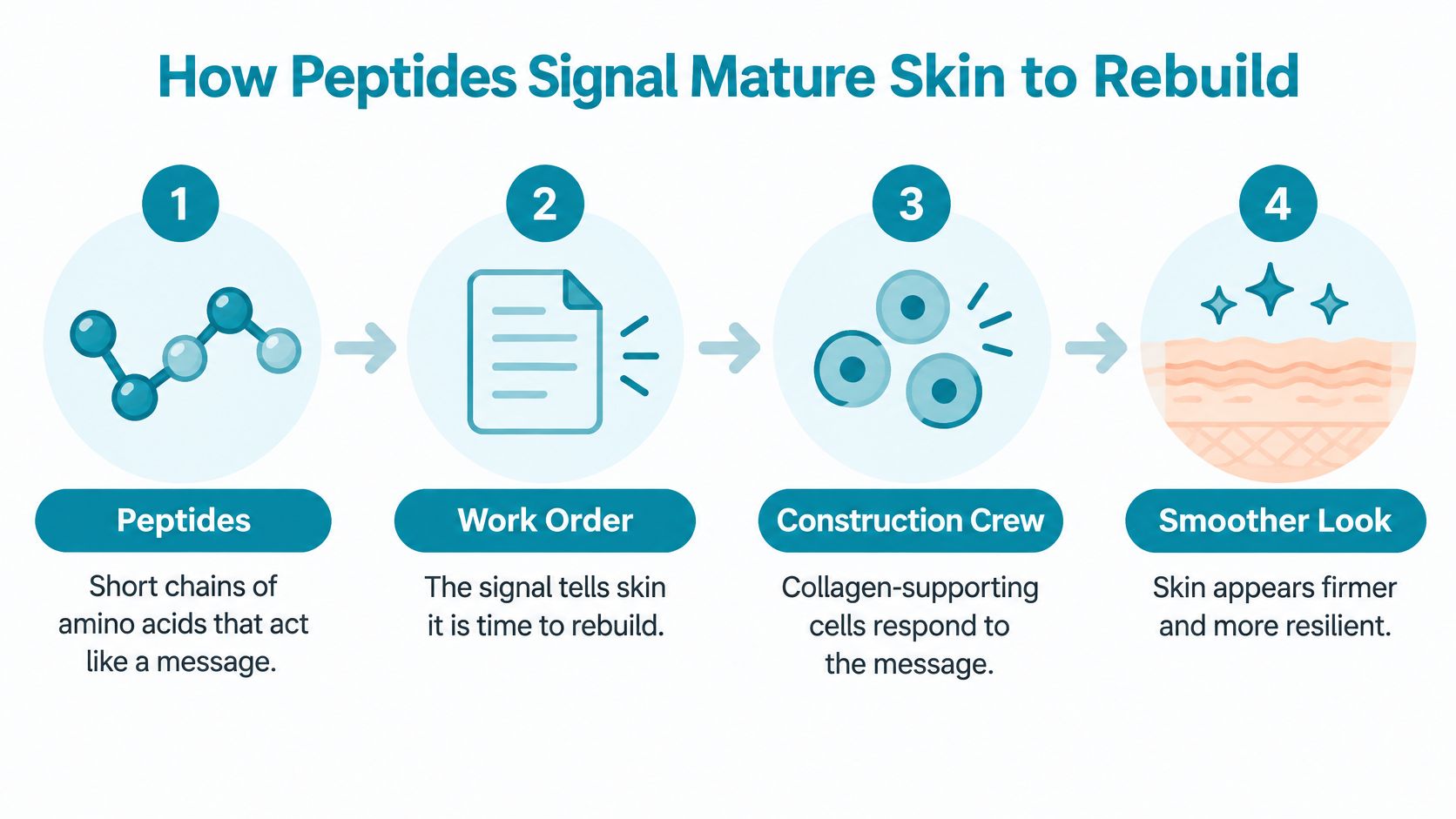
Step One Is the Message
You apply the serum to cleansed skin. The peptide sits in a water based or moisturizing formula that's designed to spread evenly and stay in contact with the surface. That contact matters, because a message can't help if it never reaches the crew.
Formulators also have to keep the peptide stable in the bottle. If the formula breaks it down before you use it, the label name means very little.
Step Two Is the Work Order
Some peptides are designed to signal skin cells involved in making structural proteins. Picture a work order clipped to a board that says, keep up the maintenance work. The peptide doesn't become collagen itself, and it doesn't do the building for the cell.
That's where confusion often starts. A signal is the start of a process, not the finished result. You can read a more specific example in this explanation of how Tripeptide 5 is used in collagen focused formulas.
Step Three Takes Time
If cells respond, they do so at a biological pace. New structural material isn't laid down in an afternoon. That's why a face can look smoother quickly from hydration while any slower change in texture needs weeks of consistent use to judge.
- Fast change you can see: Skin feels less dry, looks plumper with water, and reflects light more evenly.
- Slow change you need to track: Texture looks smoother in the same lighting after many weeks of use.
- Change you can't confirm by feel alone: Deeper structural change, which researchers need instruments or biopsies to measure.
Mature skin also varies from person to person. Dryness, sun history, sensitivity, and the rest of your routine all shape what you notice. Two people can use the same bottle and report different results without either person being wrong.
The simple test is this. Ask whether a product claim describes a message, a moisturizing effect, or a measured outcome over time. Those are three different things, and honest labels keep them separate.
Comparing Signal, Carrier and Relaxing Peptide Types
Peptide is a family name, not a single ingredient. Sorting peptides by job makes labels easier to read, because you stop asking whether peptides work in general and start asking what this type was designed to do.
Peptide Categories in Mature-Skin Serums
| Peptide Category | Intended Role | Typical Visible Change | Evidence Strength |
|---|---|---|---|
| Signal peptides | Send a message linked to collagen related activity | Skin looks smoother and firmer over weeks | Strongest human data for a few named peptides, not for every blend |
| Carrier peptides | Carry trace elements such as copper within a formula | Gradual improvement in texture and tone | Small human studies with variable individual response |
| Relaxing peptides | Target the look of expression lines | Lines around the eyes or forehead look softer | Often short term cosmetic endpoints, results vary by formula |
Signal Peptides Send the Maintenance Message
Palmitoyl pentapeptide 4, also called pal KTTKS, is the clearest classroom example. In a 12 week, double blind, placebo controlled, split face trial, 93 women aged 35 to 55 applied a moisturizer with 3 ppm pal KTTKS to one side of the face and the identical base without it to the other side, and instruments and expert grading found greater reductions in fine lines and wrinkles on the peptide side in the published split face study.
Notice what that design gives you. Each woman acted as her own comparison, and the moisturizer base was the same on both sides. That makes the result more useful than a before and after photo with new lighting.
It also sets a limit. The result belongs to that peptide, that amount, and that vehicle over 12 weeks. It doesn't automatically transfer to every product that lists a different signal peptide.
Carrier Peptides Deliver an Ingredient Partner
Carrier peptides are built to hold and deliver another component, often a mineral such as copper. Their job is closer to a delivery van than a work order. What matters is whether the complex stays intact in the formula and reaches the skin in a usable form.
Response can differ between people. That variability is normal in small cosmetic studies, and it's one reason you should test one product patiently rather than expecting the same timeline as a friend.
Relaxing Peptides Focus on Expression Lines
Neurotransmission inhibiting peptides, often called relaxing peptides in plain language, are aimed at the look of lines that form when you smile or squint. Acetyl hexapeptide 8 is a familiar label name in this group, and you can read more in this overview of Argireline in expression line formulas.
These products are cosmetics applied to the skin surface. They aren't interchangeable with medical procedures, and they shouldn't be described that way. What you can reasonably watch for is whether expression lines look softer while you use the product consistently.
A systematic review of topical peptides noted that trials remain small and often measure surrogate outcomes rather than validated clinical endpoints, which is discussed in a systematic review of topical peptide outcomes. That's not a reason to dismiss the category. It's a reason to match your expectation to the specific peptide and the endpoint that was measured.
Formulation Details That Decide Whether a Serum Delivers
Two bottles can list the same peptide and behave very differently on your face. The peptide is one line in a recipe. The rest of the recipe decides whether it stays stable, spreads well, and feels comfortable enough to use every day.
Concentration Isn't a Simple Score
A bigger percentage on the front label doesn't always mean more pure peptide. Supplier percentages can refer to a diluted peptide solution rather than pure active material. A raw material might already be dissolved in water or another carrier before a formulator adds it.
That's why the pal KTTKS example in the previous section is so instructive. The tested amount was very low, yet the study still separated the peptide side from the identical base. Dose matters, but more isn't automatically better, and a label number without context can mislead you.
You can decode other label wording with this guide to common anti aging ingredient terms. Look for the full INCI name rather than a marketing nickname alone.
The Vehicle Carries the Ingredient
The vehicle is the base that carries the peptide, such as a light serum gel or a richer moisturizing lotion. A dry, mature skin type may use a light peptide serum more consistently if a moisturizer goes over it. Someone who dislikes layering may prefer the peptide inside a cream.
Consistency sounds boring, but it's practical. A formula you skip because it pills under sunscreen won't give you a fair test.
pH, Preservatives, and Packaging Protect the Formula
Formulators must balance pH and preservative compatibility so the peptide and the rest of the system remain stable. Packaging helps too. In a one month human study of 20 healthy volunteers, increased procollagen synthesis from baseline was observed in 7 of 10 volunteers receiving a copper binding peptide cream, as reported in a Mount Sinai record of the copper binding peptide study. Peptide complexes can be sensitive to formulation conditions, so an opaque, well sealed package is a sensible sign of care.
- Read the full name: Look for specific peptides, not only the word peptide blend.
- Check the base: Note whether humectants and moisturizers suit your dryness level.
- Look at the bottle: A pump or tight seal limits air and light exposure better than an open jar.
- Watch for tolerance clues: Heavy fragrance or drying alcohol may bother a sensitive barrier, even if the peptide itself is gentle.
Label check: If you can't tell which peptide is present or what kind of base carries it, you don't have enough information to predict how it'll fit your routine.
That doesn't make the product bad. It means your decision rests on texture, tolerance, and your own tracked results rather than on a studied ingredient story.
Building a Peptide Serum Into Your Mature Skin Routine
Start simpler than you think you need to. Mature skin that's dry or easily flushed often does better when you change one product at a time. You'll also know which product caused a problem if stinging starts.
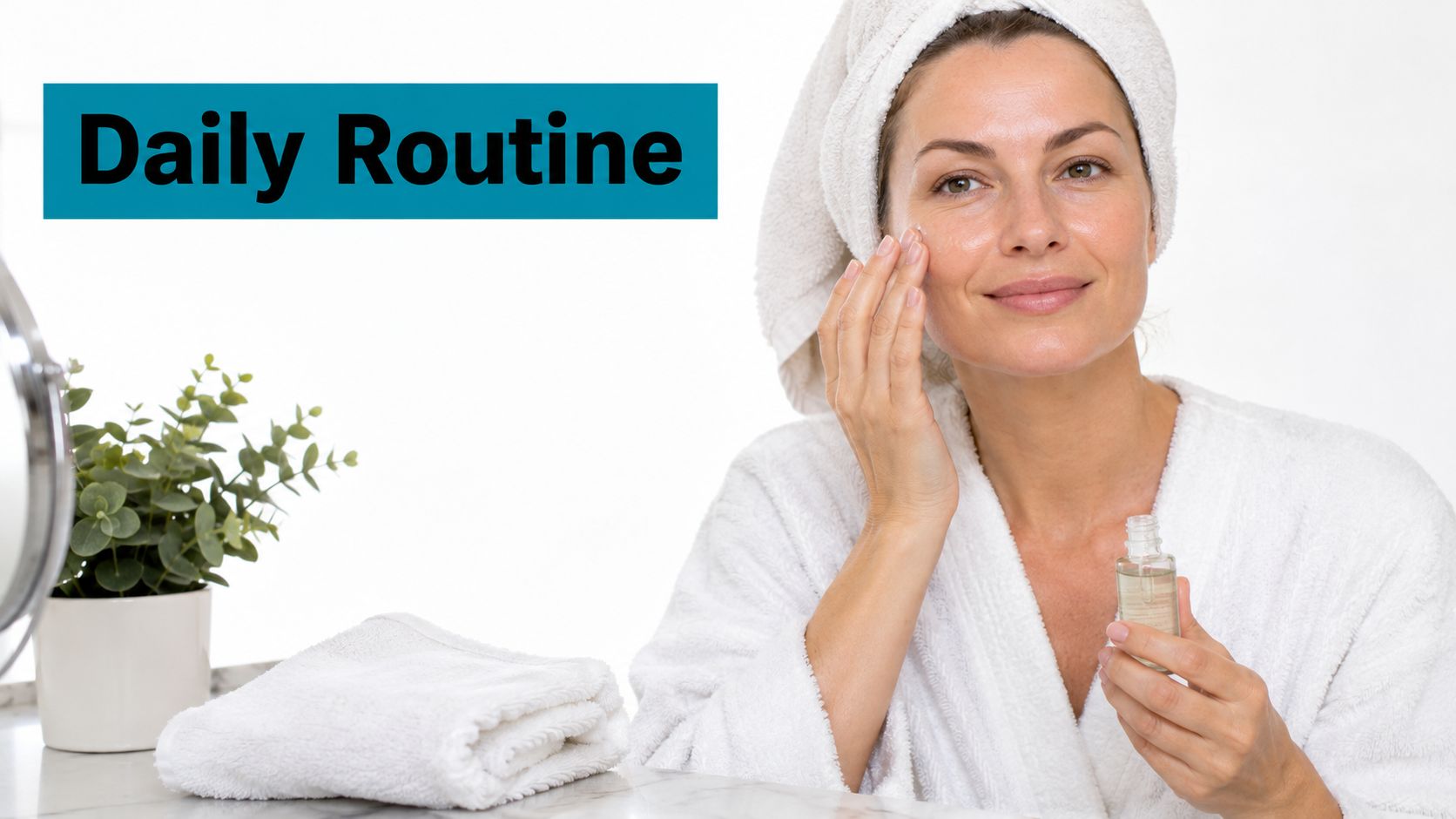
A Morning Sequence That Protects Your Test
Cleanse gently, or rinse with water if your skin feels tight after morning cleansing. Pat skin until it's slightly damp, apply the peptide serum, then add moisturizer. Finish with sunscreen as the last skincare step before makeup.
Sunscreen isn't an optional extra here. Daily sun exposure works against the smoother, more even look you're trying to maintain. If you skip it, you're judging a serum while another factor keeps changing the result.
For order questions when you add a second serum later, this walkthrough on how to layer skincare serums keeps the sequence clear without turning it into a rigid rulebook.
An Evening Sequence With Room for Stronger Actives
At night, cleanse, apply peptide serum to dry or slightly damp skin, and seal it with moisturizer. That's enough for your first two weeks. Don't introduce a retinoid, an exfoliating acid, and a peptide serum in the same week.
When you already use a retinoid or acid and your skin tolerates it, you have choices. Some people use peptide serum in the morning and keep the stronger active at night. Others alternate nights when sensitivity appears, using the retinoid one night and a peptide and moisturizer routine the next.
Vitamin C raises the same practical question. The issue for many mature skin types isn't a single forbidden pairing. It's total irritation load from several active formulas, fragrance, and exfoliation stacked together. Since published routines vary widely in peptides, doses, and assessment methods, a recent evidence summary is indexed at PubMed on topical anti aging evidence limits. Your skin's tolerance is the deciding factor you can observe at home.
Patch Test Before Full Use
- Pick one spot: Apply a small amount along the jaw or behind the ear once daily for three days.
- Watch plainly: Note burning, itching, or new bumps, not just mild warmth that fades quickly.
- Expand slowly: If the spot stays calm, use the serum every other night for a week.
- Settle in: Move to daily use only if your skin stays comfortable with moisturizer.
If your barrier already feels raw, pause new actives and return to cleanser, moisturizer, and sunscreen until your skin feels calm again.
Natural or plant derived wording doesn't guarantee a product won't irritate you. Read the full formula, patch test, and let your own response guide the pace.
Reading the Signs of Efficacy Over Weeks and Months
Meet the reader who almost quit at day ten. Her skin felt softer, but the lines beside her mouth looked the same in the bathroom light. She kept a phone photo from day one, took another at week eight in the same spot, and only then could she judge texture fairly.
That small record matters. Memory edits results, especially when you look at your face every morning.
What a 15 Minute Result Really Means
Immediate smoothing is real, but it isn't the same as long term structural change. In a 2021 randomized, double blind, placebo controlled trial, dermatologist assessment found improvement in fine lines in 97% of participants and improvement in wrinkles in 45% within 15 minutes, with 100% of subjects showing improvement in fine lines and overall appearance and median improvements of 50% and 25% respectively, in the randomized trial of a topical peptide formulation.
Read that endpoint carefully. Fifteen minutes is enough time for hydration and film forming ingredients to change how light hits the skin. It isn't enough time to prove deeper remodeling. Both effects can be useful in a cosmetic, but they answer different questions.
This timeline guide on how long peptides take to work can help you set checkpoints before you start, so you aren't deciding from one good or bad skin day.
Separate Hydration From Slower Change
In the first days, watch for comfort. Skin may feel less tight after cleansing, and makeup may sit more smoothly because the surface holds more water. Fine lines caused by dryness often look softer when skin is well moisturized.
Over several weeks, watch texture and the look of lines in standardized photos. Take them in the same light, at the same distance, with no makeup and a neutral expression. Note sleep, weather, and any new active you added, because each one can change what you see.
- Weeks one to two: Judge tolerance, dryness, and whether the texture fits under sunscreen.
- Weeks four to eight: Compare photos for smoother looking texture and softer dryness lines.
- Weeks eight to twelve: Decide whether the change is worth the cost and effort for you.
Researchers use standardized photography, profilometry, and comparison against an identical base when they need stronger evidence. You can't run a split face trial easily at home, but you can borrow the discipline. Change one variable, give it 8 to 12 weeks, and compare like with like.
If irritation builds, stop and reassess. A product that leaves you red and flaky won't give a clean reading, no matter how promising the label sounds.
Choosing a Peptide Serum and Taking the First Step
Choose by job first, then by formula. If your main concern is a firmer, plumper look, start with signal peptide formulas and a moisturizing base you'll use daily. If expression lines bother you most, a formula that also includes a relaxing peptide may fit your goal better.
Language matters when you compare products. The FDA classifies a product by intended use, and claims that a cosmetic removes wrinkles or increases collagen production can move it toward drug claims, while claims about beautifying or making lines appear less noticeable through moisturization generally remain cosmetic, as explained in FDA guidance on wrinkle treatments and anti aging products. At Skin Perfection, product listings follow that cosmetic boundary. The products beautify the skin's appearance, and they aren't presented as fixing, curing, or substituting for medicine or a procedure. Marketplace rules point the same way, since Etsy medical claims policy prohibits explicit or implied disease treatment claims anywhere in a listing.
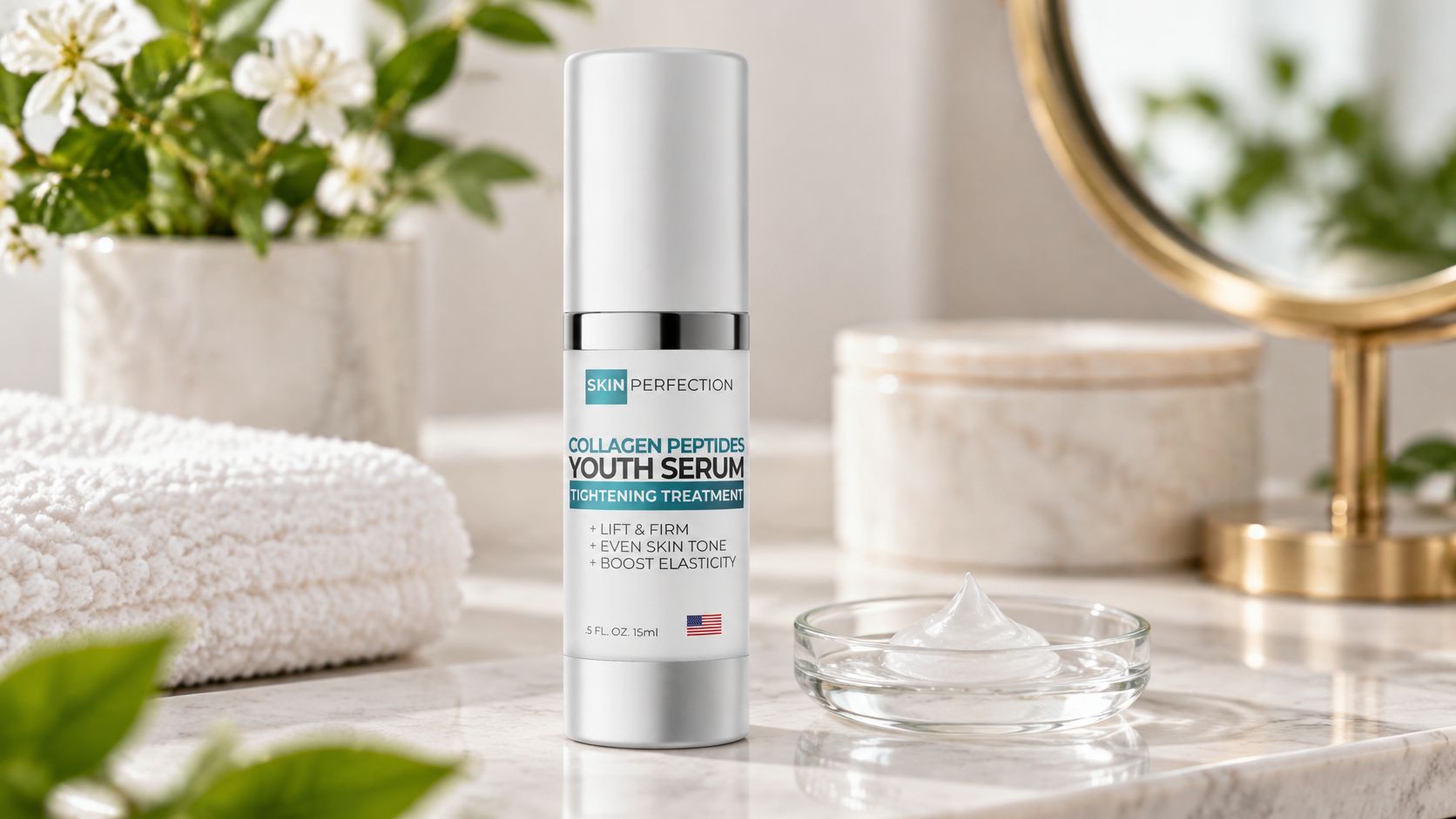
Two Formula Styles to Compare
The Youth Serum Collagen Peptide and Tightening Treatment lists 5% Syn Coll, 20% Relistase, Matrixyl 3000, Regu Age, and hyaluronic acid, and it's positioned for a firmer, plumper look. Read those percentages with the formulation lesson in mind, since listed amounts can describe supplier concentrates rather than pure peptide alone.
The Super Peptide Anti Aging Serum takes a broader approach. It lists eight peptides, including Argireline, Matrixyl 3000, and Syn Coll, and it's positioned for overall smoothing and a more youthful look. A broader blend may appeal if you want signal and relaxing peptide types in one step, while a narrower formula may be easier to judge if you're sensitive.
If you're also researching clinic based approaches so you can keep cosmetic care and medical services clearly separate, the Dream Body Clinic anti-ageing therapy guide from Dream Body Clinic outlines that very different category. A serum at home and a clinic service aren't substitutes for each other.
Your first step this week is small. Compare the full ingredient lists, pick one serum that matches your main goal, patch test it, and photograph your skin before the first full application. Then give that single choice a consistent eight to twelve week test with moisturizer and daily sunscreen.
Skin Perfection offers ready to use peptide serums and lotion making supplies for readers who want transparent ingredient lists and a calmer, cosmetic approach to mature skin care. Compare the peptide formulas discussed here, choose one that fits your goal and tolerance, and start your own tracked test when you visit Skin Perfection.