

 Buy with Prime



The usual advice about glucono delta lactone is to choose a gentle percentage and start mixing. That misses the most important part: the percentage on the label isn't a fixed acid strength. Water, heat, buffering, and time change the balance of acid species in the bottle, so a batch that seems settled at filling can read differently the next morning.
For lotion makers, that means the pH meter belongs beside the scale. For skincare users, it means choosing by percentage alone won't tell you how a product will feel.
Table of Contents
- What Glucono Delta Lactone Is
- Usage Rates and the pH That Sets Strength
- How the Slow Acid Release Works
- pH Help, Chelating and Preservative Pairings
- Serums, Toners and Other Products That Use It
- Tolerability, Patch Tests and Food-Grade Limits
- Build and Check a Small GDL Batch
What Glucono Delta Lactone Is
A jar of white crystals arrives with glucono delta lactone printed on the bag. Your serum lists gluconolactone instead. These are names for the same material, often shortened to GDL, not separate ingredients that need different recipes.
The FDA food-substance record identifies GDL by CAS 90-80-2 and lists its food regulation as 21 CFR 184.1318. Its food-processing uses include controlled acidification in products such as tofu, dairy foods, and processed meats. That helps explain why searches for this ingredient turn up both kitchen recipes and cosmetic formulas.
The powder isn't the finished acid balance
Chemically, GDL is a cyclic ester of gluconic acid. In plain language, its molecule includes a closed ring that opens when it reacts with water. Once dissolved, it progressively forms gluconic acid, which exists alongside its deprotonated form, gluconate.
Think of it as a slow-release sachet rather than a splash of lemon juice. Adding the powder starts a process; it doesn't instantly establish the finished acidity.
Say you're making a watery facial serum. The crystals disappear, the liquid looks clear, and the first pH reading looks suitable. The appearance tells you that the powder has dissolved, but it doesn't tell you that the chemical balance has stopped changing.
Dissolved isn't the same as equilibrated. A clear batch can still be changing chemically.
Give it a defined job
In skincare and lotion making, separate these roles before choosing an amount:
- Gradual pH reduction: GDL can help establish an acidic water phase.
- Surface exfoliation: Its polyhydroxy-acid-style effect depends on the finished formula, particularly its pH.
- Formula support: Gluconolactone and gluconate can contribute to preservative or chelating systems without doing every job themselves.
Those roles aren't interchangeable. A formula using GDL to support preservation isn't automatically an exfoliating serum, and a serum containing GDL isn't automatically preserved. Choose the intended job before weighing the powder.
Usage Rates and the pH That Sets Strength
Glucono delta lactone rates and what finished pH changes
| Situation | Level | Finished pH | What that means |
|---|---|---|---|
| Mild leave-on starting band | 5–10% | About 3.6–4.3 in studied cosmetic formulas, not a supplier-guaranteed pairing | Supplier starting range, not a guarantee of equal feel |
| Worked serum example | 8% | 3.5 after 24 hours | Adjusted after allowing hydrolysis to proceed |
| Broader cosmetic span cited | 2.5–14% | Around 3.6–4.3 | Percent alone doesn't set intensity |
| Near the reported pKa | Any of the above | About 3.6 | Gluconic acid and gluconate are roughly equal |
| More buffered, higher pH | Any of the above | About 4.5 | Mostly gluconate, with less free acid |
| Fresh water solution | Dissolved GDL | About 3.6, potentially falling toward 2.5 over two hours | The first reading isn't a finished-product specification |
| Research preparations, not a home start | 10% and 30% | 2.3 and 1.5, respectively | Preparations studied in 16 healthy women, not beginner recipes |
Jungbunzlauer's personal-care formulation guide proposes 5–10% as a starting band for mild exfoliating products and describes the shift from roughly equal gluconic acid and gluconate at pH 3.6 toward predominantly gluconate at pH 4.5. These are formulation starting points and chemical relationships, not a promise of comfort.
The technical discussion and split-face study published in the Journal of Cosmetic Dermatology describes the 2.5–14% cosmetic span, studied formula pH values around 3.6–4.3, and an 8% serum adjusted to pH 3.5 after 24 hours. Its 2023 split-face investigation used 10% at pH 2.3 and 30% at pH 1.5 in 16 healthy women.
Read across a row, not down the percentage column
The worked serum row describes a particular formulation process. It doesn't mean that adding the same percentage to a different base will produce the same pH, appearance, or sensation. Buffers, water content, and other ingredients affect the result.
The research preparations belong in a different category from a bathroom leave-on product. Their low pH isn't a target to reproduce at home. Controlled study use doesn't establish a general consumer recipe.
Free acid is the useful distinction here. At lower pH, a greater proportion of the hydrolyzed material is present as gluconic acid rather than gluconate. That changes acid-mediated surface exfoliation, even when the weighed amount stays unchanged.
Don't transfer another powder's instructions
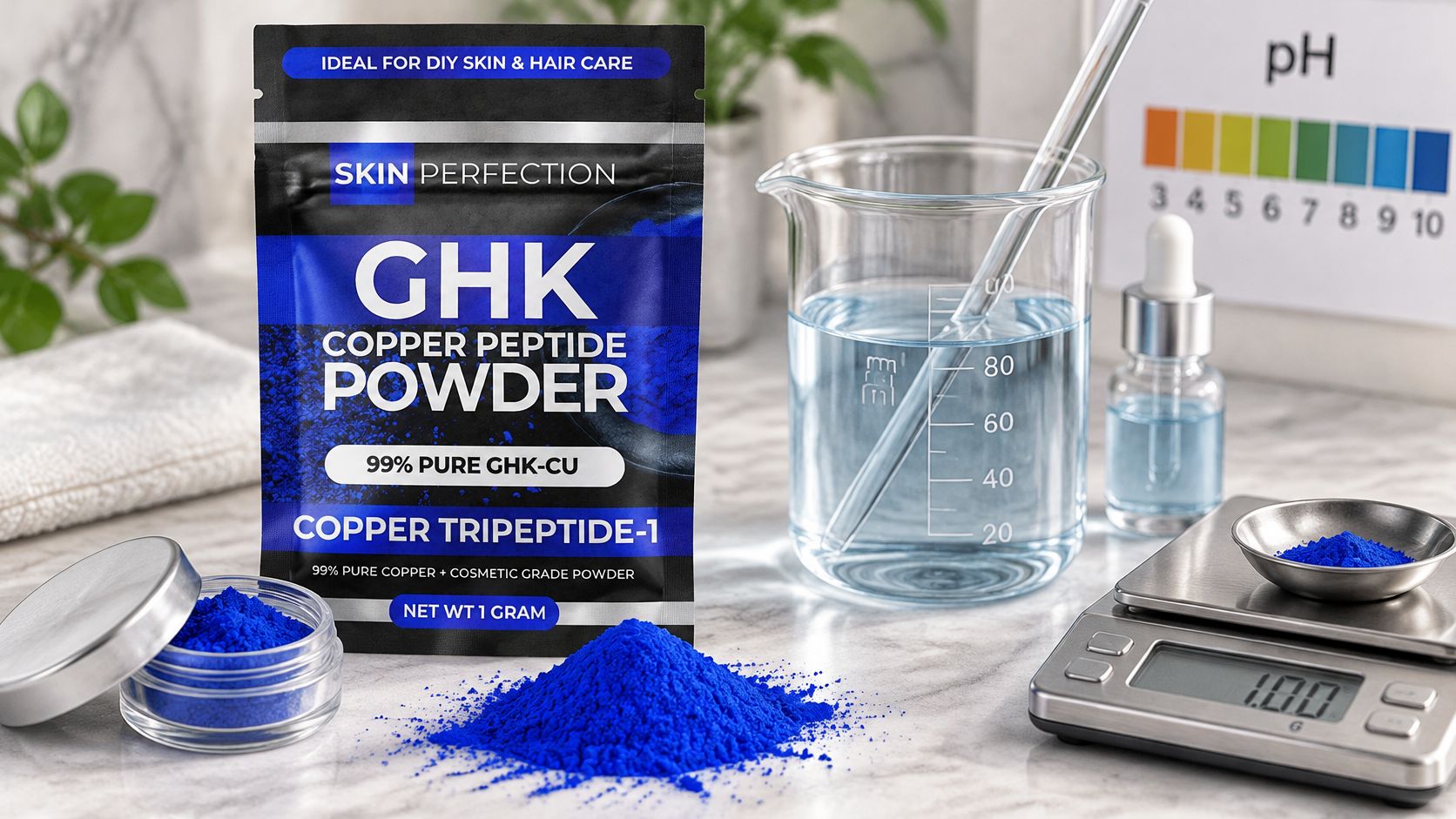
A raw-material label tells you what's in the jar, not how every finished formula will behave. The pictured GHK-Cu Copper Peptide Powder, 99% Pure (1 Gram) is a separate raw material, Copper Tripeptide-1, not GDL or a suggested addition to this acid formula.
When comparing chemical exfoliants for sensitive skin, consider the complete product and its directions rather than ranking ingredients by percentage. Choose a conservative pilot, allow it to settle, and assess the later pH before deciding whether the formula meets its intended use.
How the Slow Acid Release Works
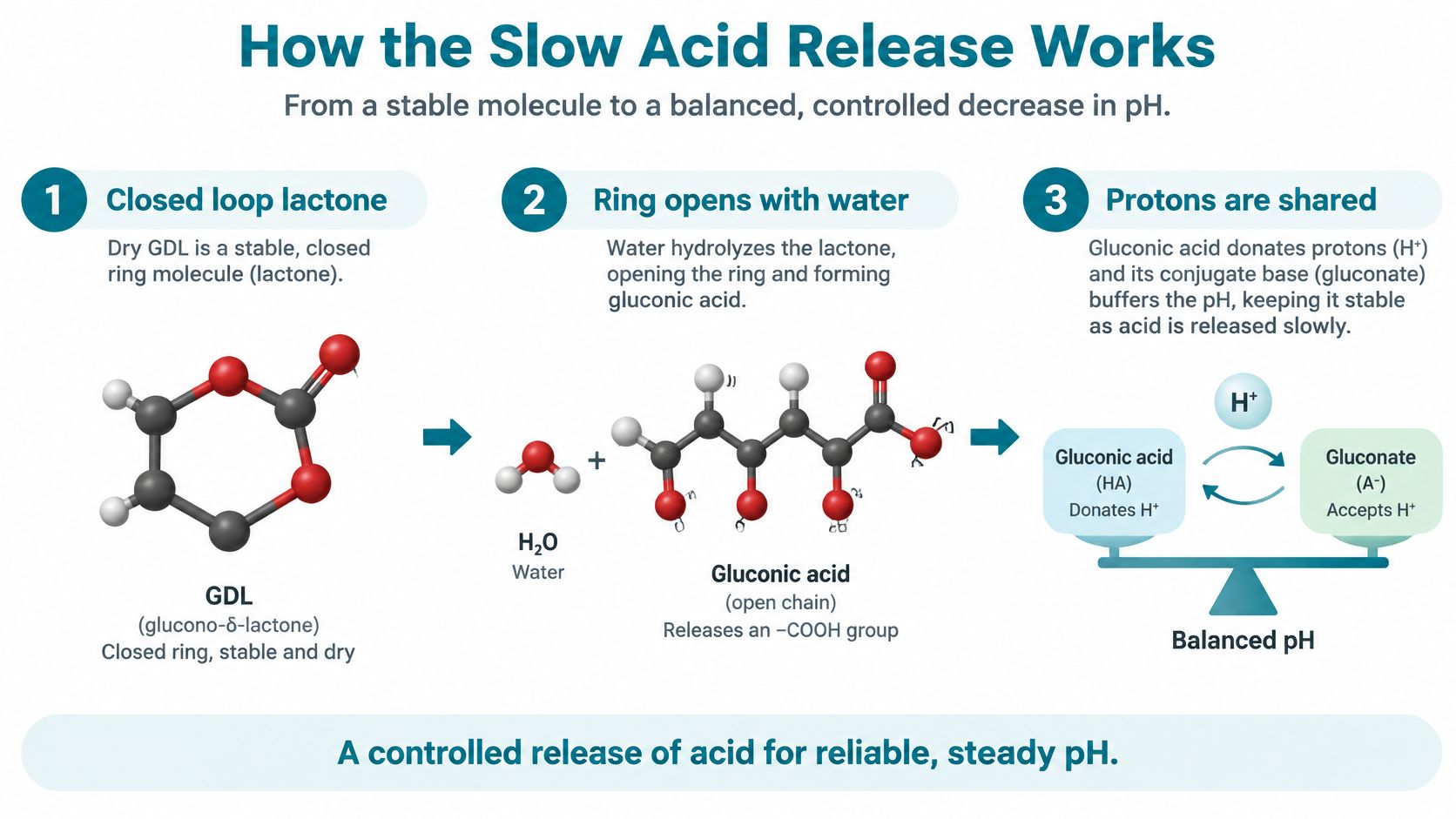
You stir GDL into water and watch the crystals disappear. What you can't see is hydrolysis, the reaction in which water opens the lactone ring to form gluconic acid. That acid can release a proton, becoming gluconate; the surrounding formula influences the balance.
PubChem's gluconolactone record identifies the molecular formula as C6H10O6, the molecular weight as approximately 178.14 g/mol, and reported hydrolysis half-lives as approximately 10 minutes at pH 6.6 and 60 minutes at pH 4. A freshly prepared aqueous solution has been reported near pH 3.6, falling toward pH 2.5 over two hours.
The clock changes with the batch
A half-life describes how quickly part of the lactone converts under particular conditions. It isn't a universal waiting period after which every lotion is finished. A more acidic environment can slow the conversion, even though the eventual product may have a stronger acid character.
The practical analogy is steeping tea. The powder is the teabag, water starts the steep, and heat changes how quickly the process proceeds. In a heated emulsion, the manufacturing history matters, so a reading taken at the stove can't stand in for a cooled-product measurement.
That makes GDL different from adding a measured amount of free acid. For another approach to water-phase adjustment, the guide to citric acid for skincare offers useful formulation context. Neither ingredient removes the need to check the finished product.
What a drifting reading changes
- Preservative performance: An acid-dependent system must remain within its specified working range.
- Surface feel: A change in acid balance can alter how the product feels during application.
- Packaging compatibility: The container, pump, and formula need assessment together at the settled pH.
- User comfort: A product shouldn't be judged only from its fresh-batch sensation.
Use a calibrated pH meter suitable for your sample, and record the measurement temperature. Thick emulsions may require a different electrode or validated measurement method from clear toners.
Write the time beside every pH number. Without it, you can't distinguish a manufacturing reading from an equilibrated-product reading.
Keep measurements from manufacture, cooling, the following day, and subsequent storage checks. If you use warm accelerated storage, retain room-temperature samples too. Neither a warm sample nor a single overnight result establishes shelf life by itself.
pH Help, Chelating and Preservative Pairings
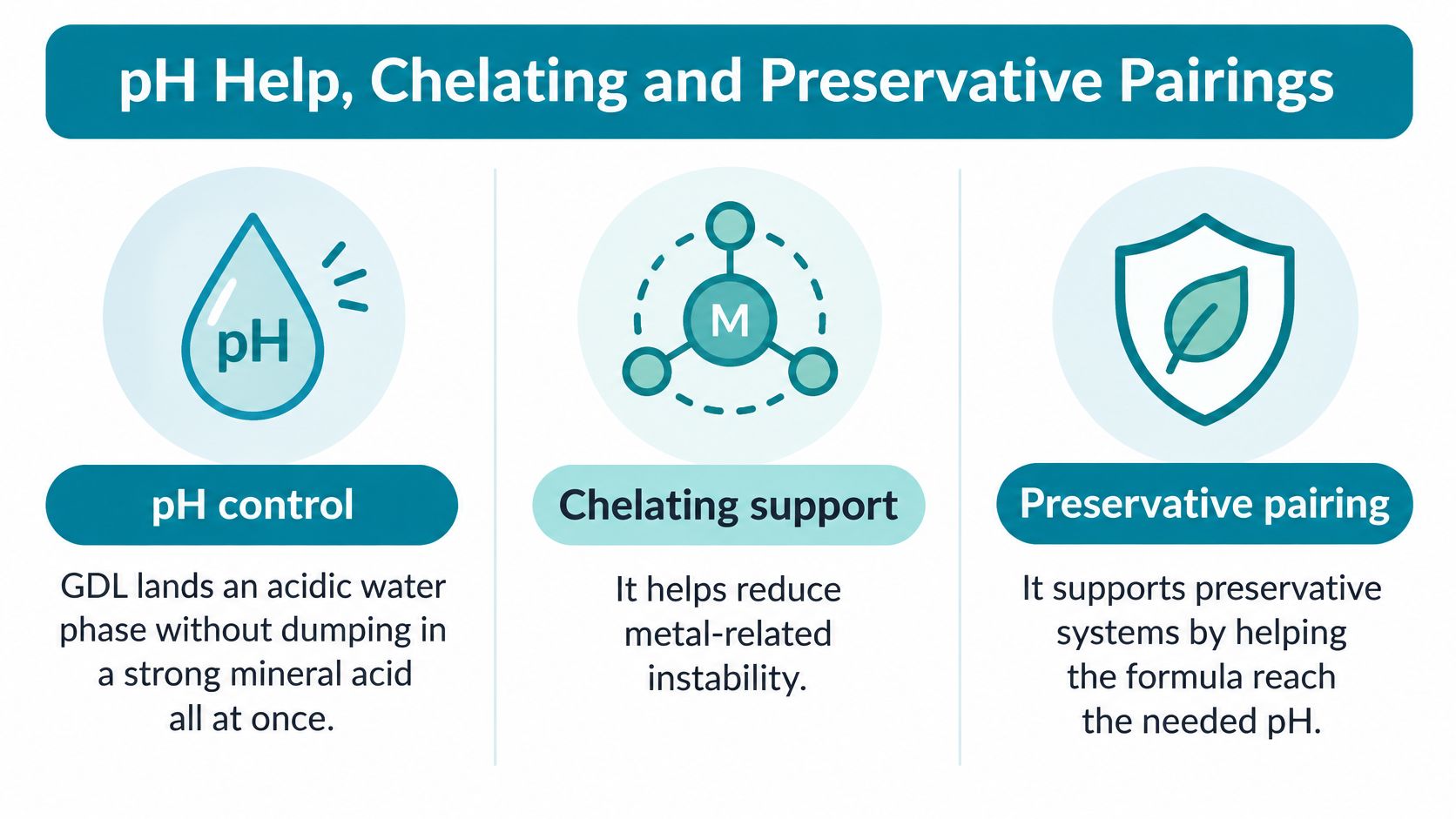
Acidification, metal binding, and preservation are different tasks. A label that lists gluconolactone beside a preservative can make them look like one operation, but the formulator still has to evaluate each task separately.
Match the contribution to the job
For pH control, GDL offers progressive acidification rather than an immediate addition of strong mineral acid. The useful outcome is a measured, suitable water phase, not just a lower number.
For chelating support, gluconate can bind some metal ions that contribute to discoloration or other instability. That contribution doesn't establish microbial protection. A lotion can look unchanged while failing a microbiological assessment.
For preservative pairing, gluconolactone may accompany sodium benzoate in a formulated blend. Acidic conditions help establish the benzoic-acid balance relevant to that system. Use the blend's actual technical documentation rather than substituting a similarly named preservative.
Three formula jobs and the partner each one needs
| Job | What GDL contributes | What still has to be decided |
|---|---|---|
| Slow pH drop | Gradual acid formation after hydration | Settled pH after cooling and an overnight check |
| Surface acid balance | Free gluconic acid in an acidic formula | Exposure, frequency, and other exfoliants in the routine |
| Chelating support | Gluconate that can bind some metals | A separate, suitable preservation strategy |
| Preservative partner | Acidification that can suit sodium benzoate blends | The complete system and its validated use conditions |
| Hot emulsion | Faster hydrolysis during heating | Cooled-product measurements and subsequent stability |
Acidifying a formula, binding metals, and preserving a formula are three different jobs.
Ferments require their own assessment
Leucidal SF Max is a salicylic-free ferment ingredient whose catalog directions specify 2–4% and discuss combining it with gluconolactone for a Burt's Bees-style lactobacillus-ferment and gluconate approach. That pairing is a formulation option, not proof that any mixture will resist bacteria, yeast, and mold throughout storage.
Blend according to its directions and evaluate the complete formula. The original radish-root ferment and the salicylic-free version shouldn't be treated as interchangeable because they share a product-family name.
Match preservation to water activity, ingredient load, manufacturing hygiene, packaging, and intended use. Water activity isn't the same thing as the percentage of water written in the recipe, and appearance can't establish it.
The discussion of sodium benzoate and citric acid provides additional context for acid-dependent preservation. If shelf life is the objective, select the preservation system first, then use GDL only where its contribution fits. Confirm performance through appropriate microbial and preservative-efficacy testing.
Serums, Toners and Other Products That Use It
A clear toner, a gel moisturizer, and a creamy lotion can all contain gluconolactone without using it for exactly the same reason. Product format helps explain the manufacturing task, but it doesn't reveal the finished acid strength.
In a watery serum or toner, the intended result may be a smoother-looking surface and an even-feeling application. Because the liquid looks simple, it's tempting to assume the formulation is simple too. Dissolution, preservation, and pH stability still need separate checks.
Clear liquids and gels
A humectant-rich gel introduces another concern: the thickener must tolerate the final acidity and electrolyte environment. If the gel becomes thin, cloudy, or uneven after adding GDL, adding more thickener blindly may hide rather than solve the incompatibility.
Dissolve the powder fully using the planned manufacturing method. Visible grit isn't a useful sign of extra exfoliating power; it's a reason to investigate incomplete dissolution, precipitation, or another source of particles.
Water quality also deserves attention when scaling beyond a kitchen-sized trial. For readers comparing water-treatment setups, Labs USA's overview of DI water equipment for pharmaceutical labs explains the equipment category. Deionization addresses dissolved ions, but it doesn't by itself establish microbiological suitability for cosmetic manufacturing.
Emulsions and supporting blends
In lotions and creams, the water phase carries GDL while the oil phase, emulsifier, and thickener determine much of the texture. Select the incorporation stage using the ingredient and emulsion-system documentation. Don't assume that adding the powder during cool-down and heating it in the water phase produce identical manufacturing behavior.
Preservative blends are another product category altogether. A supporting amount of gluconolactone beside sodium benzoate serves a different design objective from an acid-focused leave-on serum. Copying the percentage from one category into the other can change the product without achieving either objective reliably.
- Watery leave-on: Look for a defined cosmetic purpose, finished-product directions, and a stable formula.
- Gel or emulsion: Check texture and clarity alongside pH, rather than evaluating acidity alone.
- Preservative blend: Follow the complete blend's documentation, not instructions for standalone GDL.
Food applications explain the remaining search confusion. GDL can help set silken tofu, but a coagulant instruction is not a facial-product instruction.
On an ingredient list, gluconolactone placed prominently in a watery leave-on may suggest an acid-focused role. Placement beside sodium benzoate may suggest preservative support. Those are clues, not a way to calculate concentration or finished pH from the label.
Tolerability, Patch Tests and Food-Grade Limits
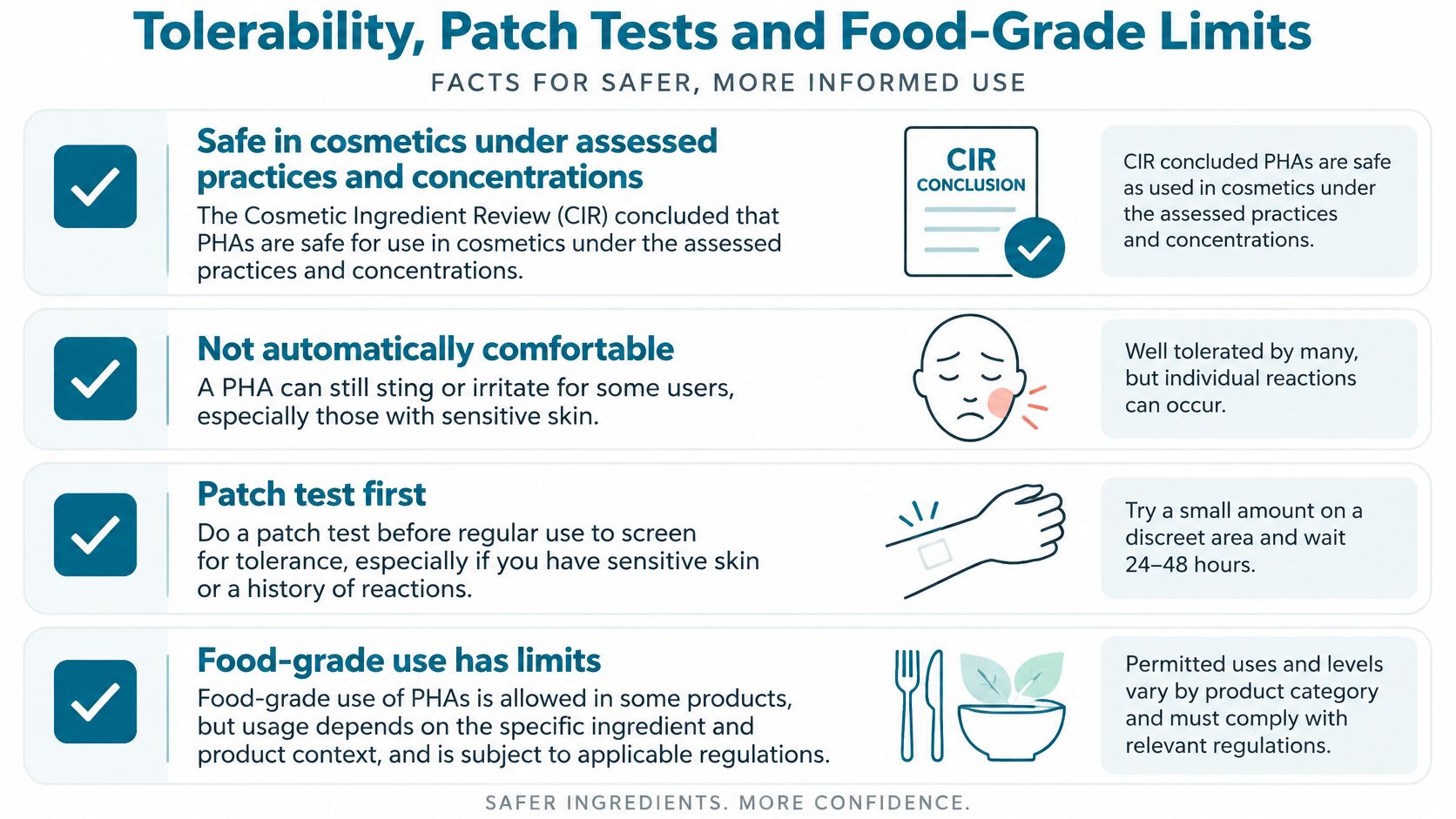
Retire gentle as a promise. A PHA-containing product can still feel uncomfortable, and an ingredient-level safety assessment doesn't establish that every concentration, pH, or combination will suit every person.
The Cosmetic Ingredient Review assessment of glycolactones concluded that gluconolactone is safe under the cosmetic practices and concentrations assessed. It also records a clinical comparison with more redness, burning, stinging, itching, and scaling in the gluconolactone group than placebo, although the differences weren't statistically significant.
Screen for comfort without chasing a reaction
The practical conclusion isn't that GDL is universally harsh or universally comfortable. Consider the finished product, exposure, frequency, and how your skin feels that day.
- Start conservatively: Trial a lower-strength, properly formulated product rather than escalating toward study preparations.
- Patch test first: Apply to a small area according to the product directions and observe before broader use.
- Avoid stacking: Don't combine strong exfoliants or retinoids when your skin already feels tight or stingy.
- Skip unsuitable areas: Avoid sunburned or broken skin.
- Stop when discomfort builds: Rinse off rather than treating persistent stinging as evidence of better results.
The guide to exfoliating sensitive skin can help you plan a more restrained routine. A home patch test is a tolerance screen, not a substitute for finished-product safety assessment.
Food history has a different scope
The JECFA toxicological evaluation records an initial evaluation in 1966, an early acceptable daily intake of 0–50 mg per kilogram of body weight per day, and a later designation of ADI not specified after review of metabolic evidence. It also reports no treatment-related toxicity or microscopic organ changes in a 26-week rat feeding study at 1% of the diet, and laxative effects associated with single human doses above 20 grams.
That history supports understanding GDL as a long-established food ingredient. It doesn't establish the suitability of a particular bag of food-grade powder for a leave-on facial formula. Cosmetic sourcing also requires appropriate identity, purity, handling, and product documentation.
The FDA cosmetic-labeling regulations guidance explains that cosmetics and their ingredients generally aren't preapproved, apart from the relevant color-additive exception. A food listing, registration, or legally marketed ingredient must not be turned into an FDA-approval claim for a cosmetic.
Personal tolerance and finished-product quality are separate checks. Neither should be inferred from the ingredient's food history.
Build and Check a Small GDL Batch
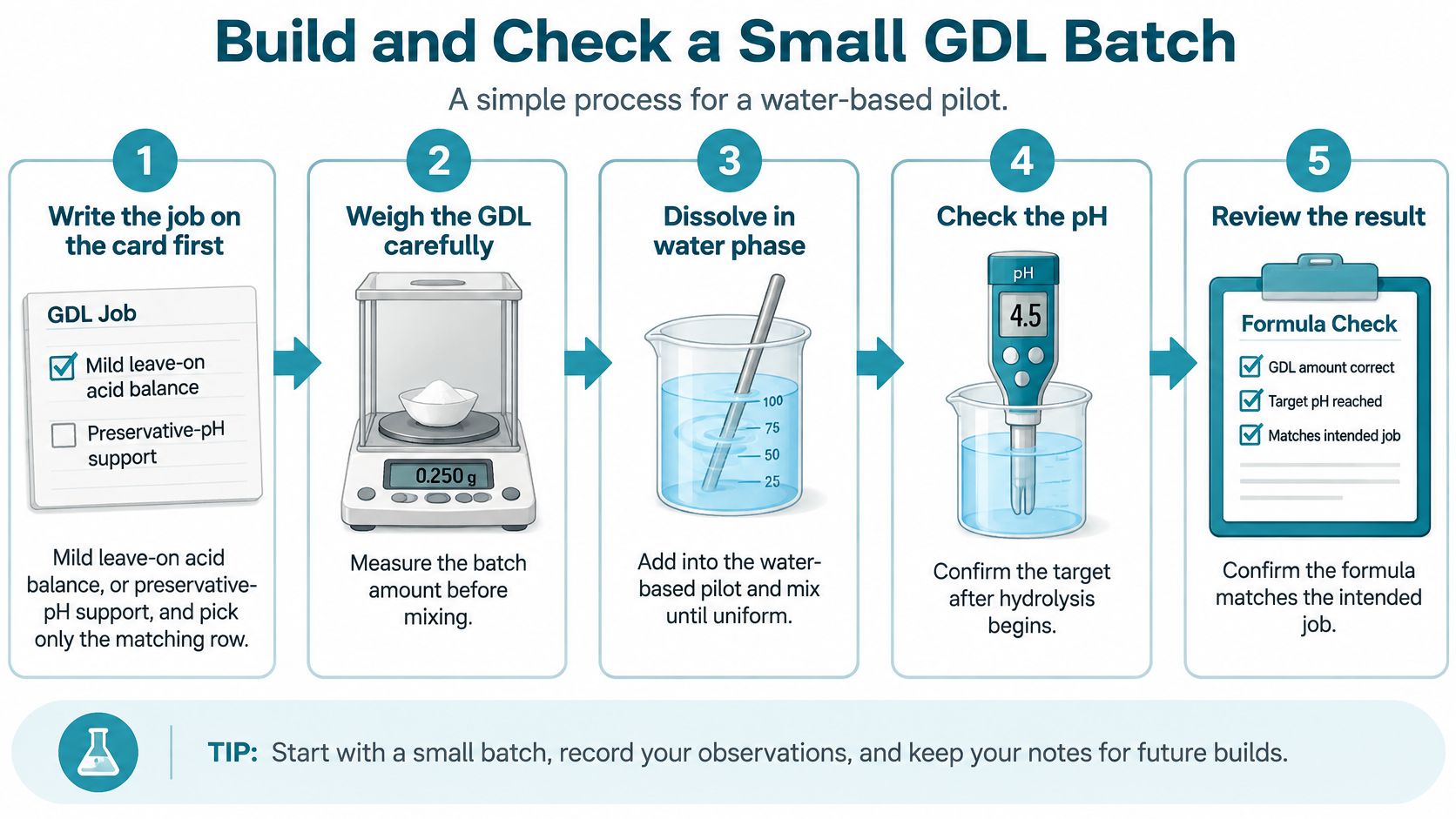
Treat a pilot as a controlled bench exercise, not a complete recipe. Use clean equipment, a suitable digital scale, a calibrated pH meter, labeled sample containers, and a notebook before opening the powder.
Keep the process traceable
- Write the intended job. Choose either surface-acid formulation or preservative-pH support. Record the target characteristics before selecting ingredients.
- Weigh and document. Record each raw material, supplier, lot, and actual weight. Leave room in the formula calculation for planned pH adjustments.
- Dissolve completely. Add GDL to the appropriate water phase and stir until uniform. Investigate grit rather than assuming extra mixing will always solve it.
- Control the manufacturing conditions. Record heating, cooling, and addition stages. Take comparable pH measurements using the same validated method and suitable sample temperature.
- Allow the balance to develop. Recheck after the overnight equilibration period before accepting the target. If adjustment is necessary, use a properly prepared dilute cosmetic pH adjuster in small additions, mix thoroughly, and record the amount.
- Use the selected preservative correctly. Incorporate it at its documented stage and conditions. Don't leave a water-based pilot unpreserved while waiting for pH to settle.
- Package and retain. Keep labeled samples in the intended container and retain a comparison sample. Track scent, color, clarity, texture, separation, and pH during storage; normal appearance doesn't establish microbial safety.
- Review before expanding. Arrange appropriate stability and preservation testing, then assess personal tolerance before regular use. Keep labeling focused on cleansing, feel, beautification, and appearance.
Finish with records, not a larger batch
The FDA guidance on cosmetic labeling claims explains that intended-use claims determine whether a product falls within cosmetic or drug regulation. Keep descriptions factual and cosmetic, and follow marketplace restrictions as well as labeling requirements.
Our cosmetic formulation resources provide a starting point for organizing a water-based project. Choose a simple formula with a defined purpose rather than adding several unfamiliar actives at once.
Your finished bench document should include a dated pH log, manufacturing notes, and a clear testing plan. A stable reading is useful evidence, but it isn't permission to skip preservation checks or assign an unsupported shelf life.
Skin Perfection offers skincare products that beautify the skin, along with a DIY section containing lotion-making supplies, airless bottles, bulk bases, powders, preservatives, kits, and formulas. Visit Skin Perfection to plan your next small water-based project, and keep your scale, pH meter, and dated batch record part of the process.