

 Buy with Prime



Most advice about sea buckthorn face oil starts with the bottle color. That is the wrong first question. Ask which part of the plant the oil comes from, how it was formulated, and what topical use can reasonably do. Fruit oil and seed oil can differ, and neither should be assumed to match an oral supplement used in research. The route of use matters.
At Skin Perfection, we sell skincare products and lotion-making supplies for cosmetic use. We describe products by their appearance and intended cosmetic use, without suggesting they fix, repair, or heal skin. That distinction keeps product claims practical and within cosmetic purposes, including under FDA rules and Etsy policies.
Table of Contents
- What Sea Buckthorn Face Oil Is and Why Plant Part Matters
- What the Evidence Really Supports for Facial Use
- Who Should Use It and Who Should Skip It
- Patch Testing and Applying Sea Buckthorn Face Oil Safely
- Making DIY Serums and Lotions With the Oil
- Writing Honest Product Claims and Choosing Your Next Step
What Sea Buckthorn Face Oil Is and Why Plant Part Matters
A bottle labeled “sea buckthorn oil” can contain oil from the fruit or pulp, the seeds, or a blend. These sources differ in color, fatty-acid and antioxidant profiles, and feel in a finished formula. Check the plant part before comparing products.
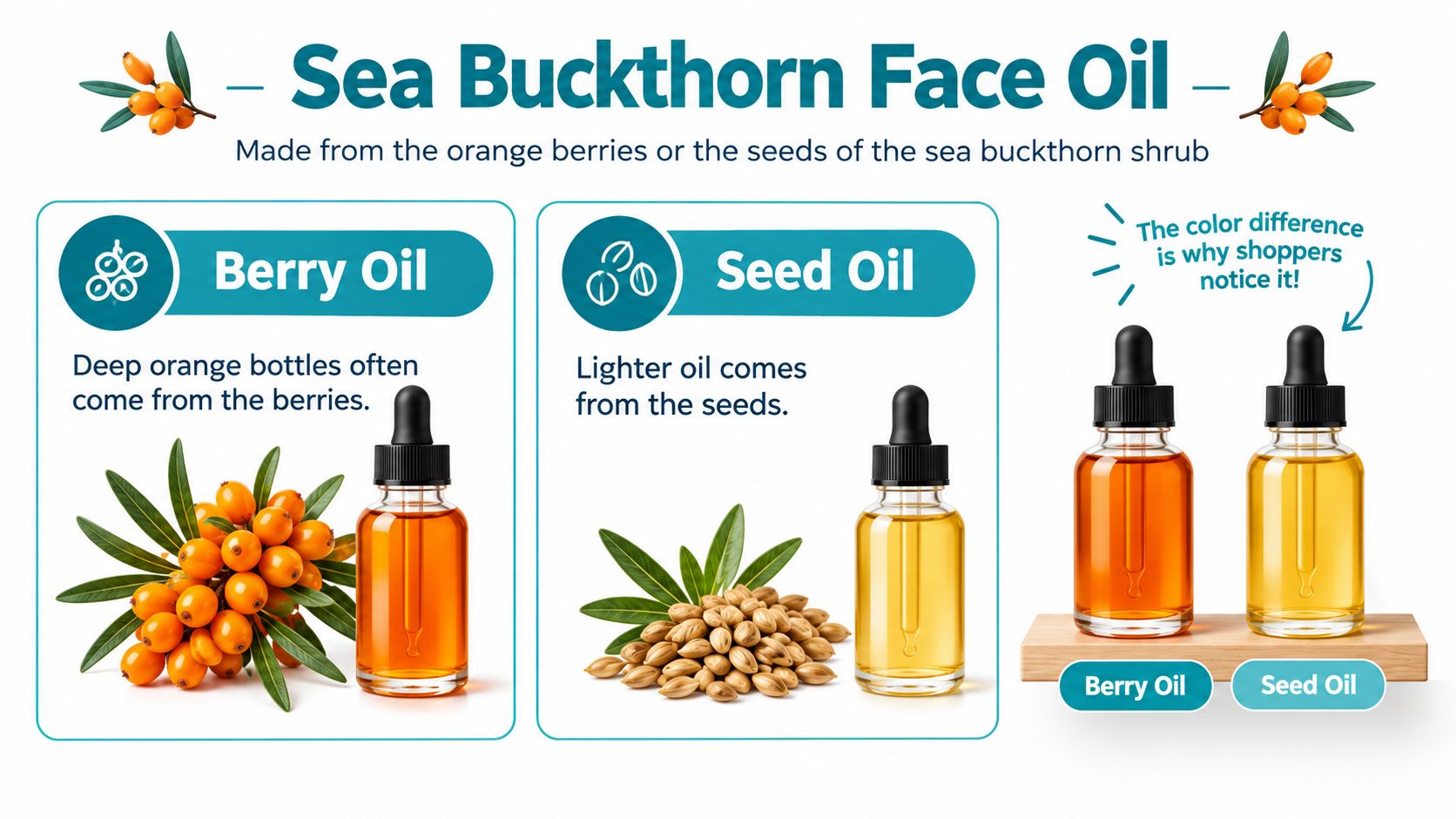
Fruit oil is often more vividly colored because it contains more carotenoids. In one analysis of sea-buckthorn oil, researchers measured approximately 206 mg/100 g of total carotenoids, with β-carotene making up about 65% of that fraction. The same study reported an oxidizability index of 0.16 and a Rancimat induction time exceeding 48 hours at 110°C. Use these figures to benchmark a sample against a supplier's spec sheet, not as a guarantee for every bottle.
That pigment has a practical trade-off. Unrefined fruit oil can look orange-red and temporarily stain pale skin or textiles, especially when applied heavily. Seed oil is usually lighter. The plant part alone, however, does not determine how a product feels or performs: extraction, refining, packaging, and the rest of the formula also matter.
How to read the bottle before applying it
Check the plant part, not just the common name. A label specifying fruit or pulp oil versus seed oil gives you a clearer basis for comparison than “sea buckthorn” alone. Look for the extraction method, carrier oils or other added ingredients, and the manufacturer's recommended use level. If those details are missing, treat color and feel as clues, not proof of composition.
Read a vivid orange shade as a sign of carotenoid content only, and judge the oil by its finished formula and how your skin responds. For a broader comparison of oil types and their roles in skincare, see this guide to carrier oils for skin.
What the Evidence Really Supports for Facial Use
Oral sea-buckthorn supplement studies examine a different route of use, so their findings cannot be transferred directly to face oil. Research on oral preparations has looked at outcomes such as skin elasticity and antioxidant markers. Topical studies, meanwhile, remain limited, and a supplement, an emulsion, and pure oil are distinct preparations.
One registered human study investigated topical sea-buckthorn creams in women aged 30–60. Participants applied the cream to their faces twice daily for 8 weeks. The registry describes the study design, but does not establish that pure sea-buckthorn face oil will produce the same results. The registered study of topical sea-buckthorn creams
A controlled emulsion study reported increased skin hydration without significant pH changes or visible erythema or oedema at 2, 24, 48, and 72 hours, and 7 days. The tested product was an emulsion, not necessarily an oil-only formula. Its findings cannot predict how every face oil, concentration, or formula will perform.
Set expectations around what you can observe
A practical cosmetic expectation is softer-feeling or more comfortable skin, especially when dryness leaves it feeling tight. That is a personal observation, not evidence of a treatment effect. Claims about wrinkle reduction, treating a skin condition, or long-term changes go beyond what the current topical research establishes.
A 2025 review calls for larger, multicenter, randomized, double-blind trials of standardized preparations before researchers can draw firm conclusions about efficacy or long-term safety. The review of sea-buckthorn research
Preliminary findings do not settle suitability for people with skin conditions. If you try the oil, assess how your skin looks and feels over time, and keep the rest of your routine steady so you can judge your response. A guide to beauty oils and their cosmetic uses can help you compare oils with other skincare formats.
Who Should Use It and Who Should Skip It
Test the particular oil and its finish against your skin, your routine, and your tolerance for pigment or richness before deciding it fits. A bottle labeled sea buckthorn oil may contain fruit oil, seed oil, or a blend, and those choices can affect its color and feel. The table offers a practical starting point for choosing where, and whether, to use it.
| Skin type | What to watch | Suggested approach |
|---|---|---|
| Dry | A rich oil may feel comfortable, but a strongly pigmented fruit oil can stain. | Consider a small amount in a finished blend, and assess the feel before applying it across your face. |
| Oily | A heavy, shiny finish may not suit your routine. | Choose a lighter blend rather than assuming all sea buckthorn oils feel alike. |
| Combination | Dry areas may feel comfortable while other areas turn shiny. | Use less overall, or apply it only to dry-feeling patches. |
| Sensitive | Fragrance, other ingredients, or the oil itself may irritate your skin. | Check the full ingredient list and consider guidance on an approach to skincare for sensitive skin. |
| Acne-prone | Evidence for ongoing use on acne-prone skin is limited. | Don't use it as an acne product; ask a professional for guidance if you're managing breakouts. |
Someone with combination skin who applies a pigmented fruit oil across the whole face may find that the cheeks stain while the T-zone turns shiny within an hour. Applying it only to dry patches avoids both problems. A lighter seed oil or blend may also feel less rich, though the finished product matters as much as the plant part.
When caution matters more than curiosity
If you have eczema, rosacea, or very reactive skin, discuss routine changes with a dermatologist rather than using sea buckthorn oil in place of care. The plant part, concentration, and finished formula vary, so another person's experience may not predict how your skin responds. The same caution applies if you are considering an oil because you read about oral supplements: findings from oral use do not establish how a topical product will suit your face.
Avoid applying the oil to broken, scraped, or freshly treated skin. Stop if irritation persists, and seek advice from a qualified professional when a skin condition needs care. A botanical ingredient can still be a poor fit for an individual routine.
Patch Testing and Applying Sea Buckthorn Face Oil Safely
Treat the patch test as a first check. It does not guarantee your face will tolerate the oil. Apply a small amount to an unobtrusive area, such as the inner forearm or behind the ear, and leave it in place for 24–48 hours. Watch for redness, itching, burning, or irritation. If a reaction develops, wash the area and do not apply the oil to your face.
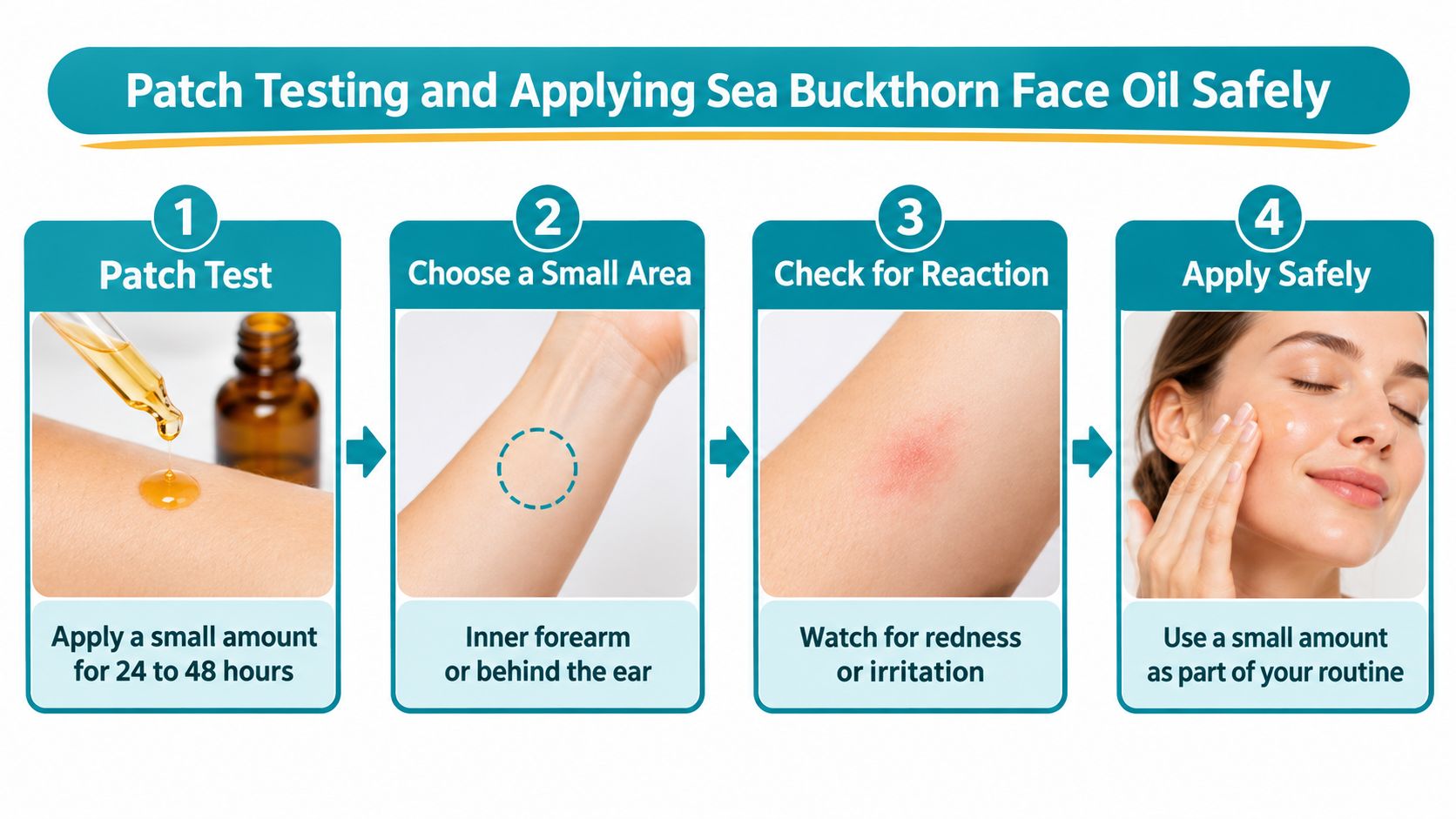
If the test area stays calm, start with 1–2 drops on slightly damp skin once nightly for one week. Press the oil gently onto your skin instead of rubbing it back and forth. A small amount makes it easier to assess the finish and avoid applying too much of a richly colored oil.
Place it where it makes sense in your routine
Apply water-based products before oil. If you use a hydrating serum or moisturizer, let it settle, then press the oil over it if the combination feels comfortable. Face oil does not replace sunscreen. In the morning, let the oil settle before applying sunscreen. If the sunscreen beads up or rolls off within a minute of application, wait longer after the oil or use a lighter oil in the morning.
Keep the amount and frequency modest at first. After the first week, increase to twice daily only if your skin tolerates the oil and its finish suits you. More frequent use is not automatically better. If it feels too heavy, looks too orange, or transfers to fabric, use less or stop.
Practical rule: Keep the rest of your routine steady while you assess a new oil. That makes it easier to notice whether the product suits you.
Make a brief note about how your skin feels and looks before starting. Compare that with your experience during use, and stop applying the oil if irritation persists rather than trying to push through it.
Making DIY Serums and Lotions With the Oil
Sea buckthorn oil can tint an oil serum quickly, so begin with a light carrier such as jojoba and add a small amount of the sea buckthorn oil. Check the blend's color, scent, and feel before adding more. Fruit oil and seed oil can differ in color and composition, so check which plant part your ingredient comes from rather than assuming every bottle will behave the same way.
A lotion needs an emulsifier to combine its oil and water phases, plus a preservation plan suited to the formula. Adding oil to water alone does not make a stable lotion. Follow the instructions for the emulsifier and preservative you select, then assess the finished product's stability and compatibility.
Match the active to the base
Water-soluble ingredients such as Matrixyl 3000 will not dissolve in an oil-only base, so they belong in a compatible water-based serum or lotion. For a formula that includes water-soluble ingredients, use a DIY face serum recipe guide as a starting point. Follow the specific handling and preservation instructions for each ingredient.
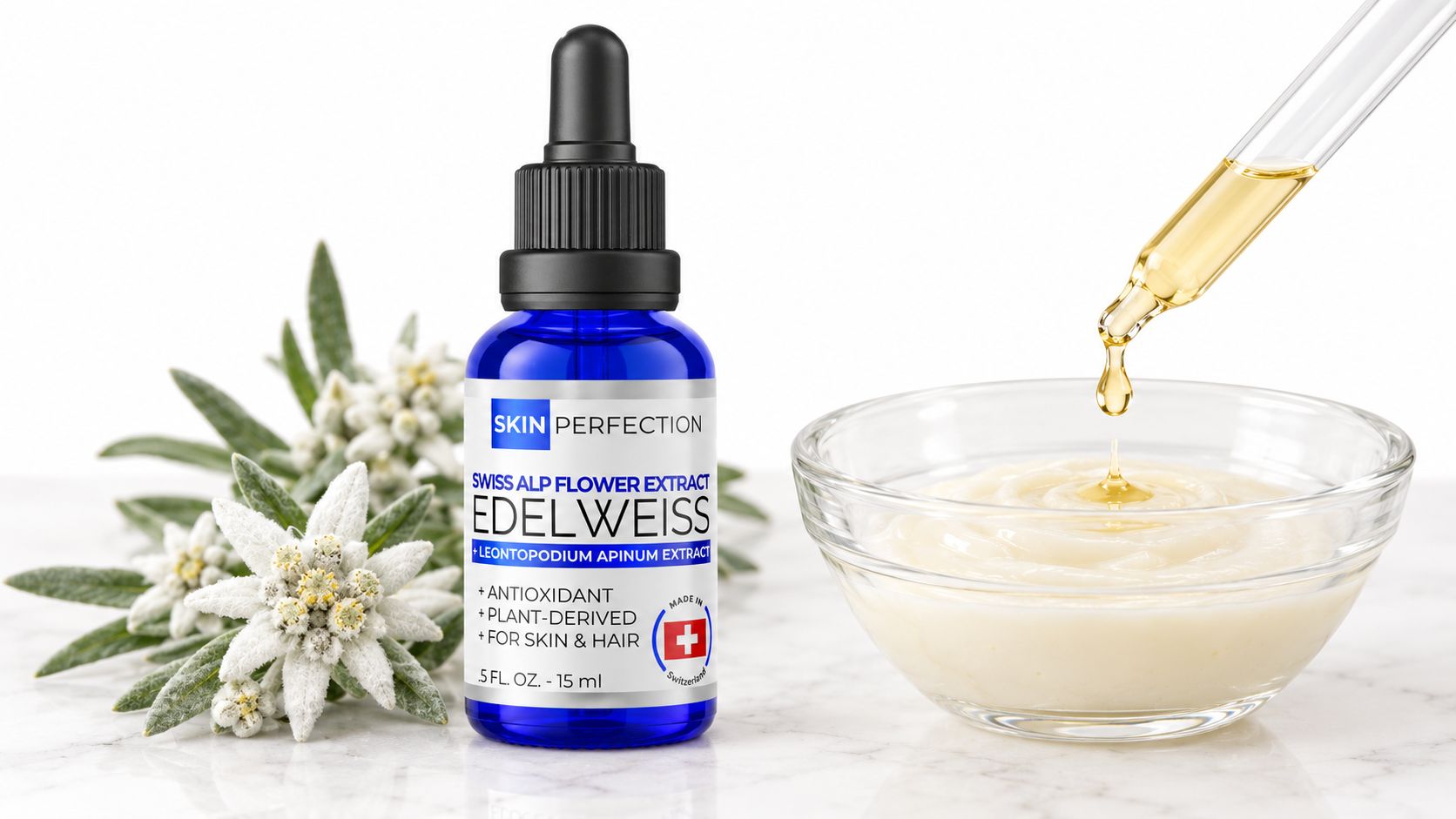
The Edelweiss Serum Booster is a botanical concentrate derived from Leontopodium alpinum petals. It can be added to compatible existing serums or creams. Check the current label for its recommended use level before formulating. It suits compatible serum or lotion bases, rather than serving as a carrier oil for an oil-only blend. For professional skincare options, see skin care services in Stuart.
Protect the finished oil
Start oxidation control with raw-material checks, then protect the finished oil with packaging and storage. Verify the botanical source and extraction method, and consider checking peroxide value, anisidine value, fatty-acid profile, tocopherols, and carotenoids. These results can help compare batches, but they cannot establish a guaranteed shelf life for every formula.
Choose opaque containers with minimal headspace, and store them in a cool, dark place. Heat, light, repeated air exposure, and contaminated droppers can accelerate rancidity, even in oils with natural antioxidants. Make small batches, keep dispensing tools clean, and check the product's scent and appearance during storage. If you make a product for others, run accelerated stability testing before assigning a shelf life.
Writing Honest Product Claims and Choosing Your Next Step
Good cosmetic copy tells shoppers what a product is intended to do for skin's appearance or feel. In the United States, the FDA does not preapprove cosmetics or keep a list of approved cosmetic claims. Labels and marketing still must be truthful and not misleading. Claims that a product treats or prevents disease, or affects the body's structure or function, can bring it under drug requirements. See the FDA guidance on cosmetic and drug intended use and FDA guidance on cosmetic labeling claims.
For a sea buckthorn face oil, use descriptions such as moisturizing, conditioning, softening, or beautifying only when they accurately describe the product. Do not call a cosmetic FDA-approved or suggest the FDA has endorsed its effectiveness. Skin Perfection offers skincare listings and lotion-making supplies as examples of cosmetic products and ingredients.
Keep marketplace descriptions within policy
Etsy's medical-claims policy applies to listing titles, descriptions, and images. It prohibits claims that an item prevents, treats, diagnoses, mitigates, heals, or cures a disease or medical condition, as well as claims that it replaces or matches the effectiveness of a prescription drug, over-the-counter medication, vaccine, or medical procedure. The policy applies even if a seller believes a claim is accurate.
Keep disease language, treatment promises, medication comparisons, and therapeutic claims out of every part of a listing. Instead, describe the oil's texture, color, ingredients, and intended cosmetic use. For broader ingredient context, consult this guide to clean beauty ingredients.
For your next batch or purchase, choose a base suited to the format, patch test the finished product, and keep a two-week log of how your skin looks and feels. Record the product, amount, and any changes in comfort or appearance. This gives you a practical basis for deciding whether the formula suits your routine, rather than relying on a percentage promise on a label.
Skin Perfection offers skincare products and lotion-making supplies for people choosing or making cosmetic formulas, including ingredients for serum and lotion projects. Visit Skin Perfection to explore options for a sea buckthorn blend.